The history of Lisbon: A Guide Through the Centuries
The history of Lisbon survives in Roman foundations, medieval lanes, earthquake-resistant buildings and the squares where Portugal changed direction. This guide connects the city’s defining moments with places you can still explore, helping you decide what deserves time on your visit.
The history of Lisbon in 11 key moments
Lisbon’s position beside the Tagus estuary explains much of its story: a sheltered Atlantic trading port, a royal capital and the centre of an overseas empire. Its past also includes conquest, slavery, natural disaster, dictatorship and democratic renewal. These are the turning points that make the present-day city easier to understand.
01An Atlantic trading settlement (8th–2nd centuries BCE)
Archaeological evidence places Lisbon within Phoenician trading networks during the first millennium BCE, alongside local communities already living around the Tagus. The hill beneath today’s castle offered a defensible position above the river. The familiar story that Ulysses founded Lisbon belongs to legend, not established history. Insider tip: begin at the archaeological area of Castelo de São Jorge, where the layers beneath the medieval city matter as much as the ramparts.
02Roman Olisipo (2nd century BCE–5th century CE)
Lisbon came under Roman control during Rome’s expansion across the Iberian Peninsula and became known as Felicitas Julia Olisipo. Its theatre, baths and fish-processing installations reveal a prosperous port linked to wider Roman trade. After Roman authority weakened, the city passed through successive Germanic rulers. Insider tip: visit the Roman Theatre Museum before descending towards the river; its hillside setting helps explain how Roman builders used Lisbon’s steep terrain.
03Islamic al-Ushbuna (c. 714–1147)
Under Muslim rule, Lisbon was known as al-Ushbuna and belonged to the changing political landscape of Islamic Iberia. Fortifications, archaeological finds and place names preserve traces of this long period. Alfama’s name derives from Arabic, although its present buildings and street pattern reflect many subsequent centuries. Insider tip: avoid treating every narrow lane as an untouched medieval survival; look for dated archaeological evidence at the castle instead.
04The conquest of Lisbon (1147)
Afonso Henriques, Portugal’s first king, captured Lisbon after a siege supported by northern European crusaders. The conquest brought violence, displacement and a new Christian political and religious order. Construction of Lisbon Cathedral began in the following decades, traditionally associated with the site of the principal mosque. Insider tip: compare the cathedral’s fortress-like façade with its later architectural additions; the building is a record of rebuilding, not a single frozen moment.
05Royal capital and a struggle for independence (1255–1385)
Lisbon became the principal royal seat under Afonso III in 1255, the date conventionally used for its emergence as Portugal’s capital. During the succession crisis of 1383–1385, the city supported the Master of Avis, the future João I, and endured a Castilian siege in 1384. Insider tip: seek out the surviving Fernandine wall in the courtyard of the Pátio da Dom Fradique, near the castle, to connect medieval defensive works with the modern neighbourhood.
06Maritime expansion and imperial wealth (15th–16th centuries)
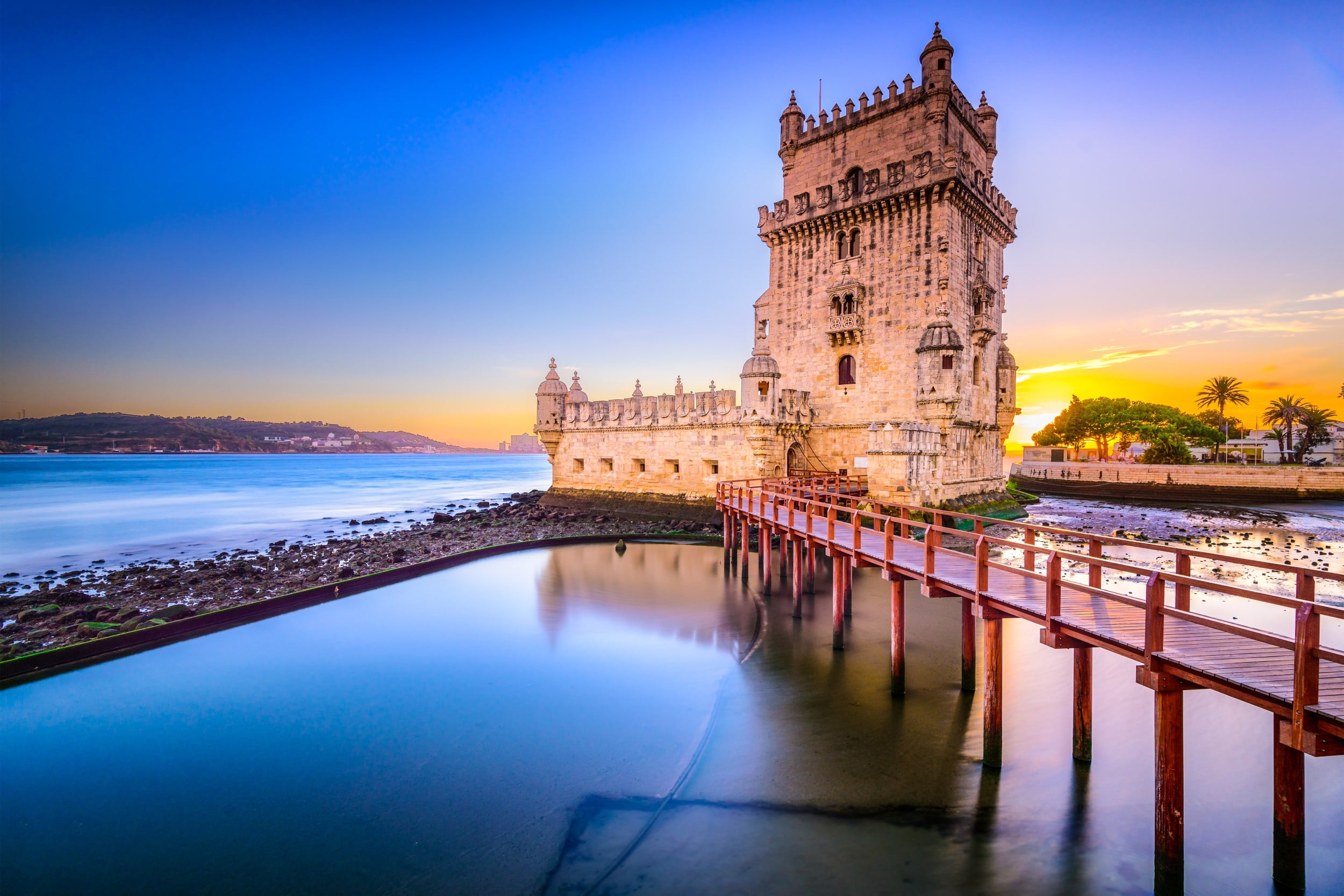
Lisbon became a major centre for voyages linking Europe with Africa, Asia and Brazil. Vasco da Gama departed from Belém in 1497, while Manuel I’s reign produced landmarks including Jerónimos Monastery and Belém Tower. Commerce enriched the city, but empire also depended on conquest, exploitation and the trafficking of enslaved Africans. Insider tip: read Belém’s monuments as evidence of royal power and imperial ideology, rather than simply decorative celebrations of navigation.
07The Iberian Union and Restoration (1580–1640)
A Portuguese succession crisis brought the country under the same monarchs as Spain in 1580, although Portugal retained distinct institutions. On 1 December 1640, a coup in Lisbon initiated the restoration of an independent Portuguese monarchy under João IV. Insider tip: pause at the monument in Praça dos Restauradores; its name commemorates the Restoration, not the rebuilding after the earthquake.
08Earthquake, tsunami and reconstruction (1755–late 18th century)
On 1 November 1755, a major earthquake struck Lisbon, followed by a tsunami and extensive fires. Reconstruction under José I and his powerful minister, later titled Marquis of Pombal, reshaped the lower city with broad streets, regular blocks and buildings incorporating timber anti-seismic structures known as gaiola pombalina. Insider tip: walk from irregular Alfama into the Baixa grid; the change in street layout is one of Lisbon’s clearest historical contrasts.
09Invasion, political upheaval and the Republic (1807–1926)
As French troops advanced in 1807, the Portuguese royal court departed for Brazil, temporarily shifting the monarchy’s centre of government to Rio de Janeiro. Constitutional struggles followed during the 19th century. The monarchy ended with the proclamation of the Republic in Lisbon on 5 October 1910. Insider tip: visit Praça do Município and look towards the City Hall balcony associated with that proclamation, rather than assuming it happened in Praça do Comércio.
10Dictatorship and the Carnation Revolution (1933–1974)
The Estado Novo dictatorship was formally established in 1933, following the military coup of 1926. Censorship, political imprisonment and colonial wars shaped Portuguese life until the military-led revolution of 25 April 1974 opened the way to democracy. Largo do Carmo became a decisive location when Marcelo Caetano surrendered at the GNR headquarters. Insider tip: pair the square with the Aljube Museum to understand both the revolution’s public drama and the repression that preceded it.
11European integration and a new waterfront (1986–present)
Portugal joined the European Economic Community in 1986. Lisbon’s Expo ’98 then transformed a former industrial area in the city’s northeast into what became Parque das Nações, while the Vasco da Gama Bridge opened that same year. These developments added a new chapter without replacing the older city. Insider tip: compare Parque das Nações with Praça do Comércio; both face the Tagus, but express very different ideas about Lisbon’s relationship with the world.
Trusted across Portugal and Spain
Journeys backed by 1,300+ verified reviews
Consistently five-star rated since 2012, Portugal Magik is a TripAdvisor Hall of Fame recipient. Our Portugal Ambassadors bring local knowledge, thoughtful service and dependable private travel to every journey.

Travel with Portugal Magik
Explore Portugal in a Mercedes-Benz V-Class
For smaller groups, a private V-Class offers a comfortable way to travel between places, with an English-speaking driver, door-to-door pickup and a flexible itinerary planned with our team. Vehicle choice depends on your group and availability.
Plan a personalized journey →Historic sites Lisbon visitors can explore today
The most rewarding Lisbon history itinerary mixes monuments with streets and public spaces. Museum interiors provide evidence and context; outside, distances, slopes and sightlines explain why events unfolded where they did.
01Castelo de São Jorge and its archaeological site
The castle hill is the best starting point for understanding Lisbon’s defensive geography. Its archaeological remains span periods much older than the visible fortress, whose present appearance also reflects substantial 20th-century restoration. The river views help explain the strategic value of the site. Insider tip: allow time for the archaeological interpretation, not just the battlements, and check whether archaeological visits have separate access arrangements.
02Lisbon Cathedral and Alfama
The Sé anchors the story of the Christian conquest, while Alfama illustrates how a neighbourhood can preserve an irregular street pattern despite centuries of alteration. Parts of this eastern district escaped the complete destruction experienced in the lower city in 1755, but it was not untouched by disaster. Insider tip: explore downhill where possible; polished calçada paving can be slippery, particularly after rain.
03Museu de Lisboa
Teatro Romano** — Near the cathedral, this museum reveals the remains of Olisipo’s Roman theatre and displays finds that help reconstruct life in the ancient city. It offers a valuable corrective to the idea that Lisbon’s story begins with medieval kings or Atlantic voyages. Insider tip: look at the relationship between the excavated seating area and the slope; the terrain itself helps you understand the original structure.
04Carmo Convent and Largo do Carmo
The roofless nave of Carmo’s church is Lisbon’s most immediately legible reminder of the 1755 earthquake. Outside, Largo do Carmo carries a different association: the surrender of the head of government during the 1974 revolution. Together, church and square connect physical destruction with political transformation. Insider tip: treat these as two separate historical stops, even though only a few steps divide them.
05Baixa and Praça do Comércio
The rebuilt Baixa makes Pombaline planning visible at street level. Rua Augusta follows the orderly grid towards Praça do Comércio, laid out where the royal Ribeira Palace stood before the earthquake. Street names such as Rua dos Sapateiros and Rua do Ouro recall the trades associated with the district. Insider tip: look along several parallel streets before reaching the waterfront; the repetition is the historical point, not merely a convenient walking route.
06Jerónimos Monastery and Belém Tower
About 7 km west of Praça do Comércio, depending on the route, Belém concentrates major monuments of the Manueline age. Jerónimos demonstrates the resources and symbolism of Manuel I’s monarchy, while the early-16th-century tower formed part of the Tagus defences. Insider tip: distinguish these monuments from the nearby Padrão dos Descobrimentos, whose permanent version dates to 1960; it reflects a much later interpretation of the maritime past. Check current access before planning interior visits.
07Praça dos Restauradores and Praça do Município
These two squares commemorate different political turning points: the restoration of Portuguese independence in 1640 and the proclamation of the Republic in 1910. They sit roughly 1 km apart on foot through central Lisbon, making them useful anchors for a political-history walk. Insider tip: photograph each monument or building with its date noted; otherwise, several centuries of regime changes can blur together.
08Museu do Aljube
Resistência e Liberdade** — Housed in a former prison beside the cathedral, the Aljube Museum examines dictatorship, resistance and the struggle for liberty. Its testimony and interpretation give essential context to the more celebratory story of April 1974. Insider tip: leave time to read rather than treating this as a quick photo stop; it is a thoughtful counterweight to a morning of royal and religious monuments.
09Parque das Nações
Around 10 km northeast of the Baixa by road, this waterfront district shows the urban transformation associated with Expo ’98. The Portugal Pavilion, designed by Álvaro Siza Vieira, is especially useful for understanding the architectural ambitions of that period. Insider tip: look at the pavilion’s sweeping suspended concrete canopy, then compare the district’s open waterfront spaces with the formal enclosure of Praça do Comércio.
You do not need to cover every site to understand Lisbon. Ask Portugal Magik for a personalized route built around the periods that interest you most, whether that means Roman archaeology, the earthquake or Portugal’s transition to democracy.
How a private guided day brings Lisbon’s past to life
A good historical day follows a clear thread rather than collecting monuments. For a first visit, a realistic seven- to eight-hour outline combines the castle hill or cathedral area, the reconstructed Baixa and Belém, with a lunch break and time for selected interiors. Visiting every museum listed above would require more than one day.
Start with the older city in the morning, choosing either the castle or the Roman theatre as your principal visit. Continue through the cathedral area towards the lower city, using the changing street pattern to explain the impact of 1755. After lunch, travel west to Belém for the maritime chapter. If modern political history matters more to you, replace Belém with the Aljube Museum and Largo do Carmo rather than trying to squeeze everything in.
Portugal Magik offers private day and multi-day tours and private Mercedes-Benz transfers, with an English-speaking driver, door-to-door pickup and flexible itineraries. Your Portugal Ambassador is a knowledgeable local English-speaking driver-guide from Portugal who can connect the sites with the wider story and help shape a manageable day. For smaller groups, a private Mercedes-Benz V-Class is a comfortable option for journeys between districts, subject to availability.
A vehicle is particularly useful for linking central Lisbon with Belém or Parque das Nações, but it cannot remove every hill or bring you to every monument entrance. Historic streets include pedestrian areas, steps and restricted vehicle access. Share any mobility concerns when requesting your route so walking sections and suitable drop-off points can be considered; museum hours and current monument access also need to shape the plan.
Established in 2012, Portugal Magik has 1,300+ verified reviews, is consistently five-star rated and holds TripAdvisor Hall of Fame recognition. If you would prefer a focused day to a long checklist, request a personalized private tour quote with your preferred historical themes and starting point.
Your route
Direct or with stops
Tell us where you would like to pause along the way and we shape the day around it.
Request a proposal →Your pace
One day or several
Spread the journey over a few days with overnight suggestions from our team.
Request a proposal →Your Ambassador
A local by your side
An English-speaking driver-guide from Portugal in a private Mercedes-Benz.
Request a proposal →★★★★★ 1,300+ verified reviews · TripAdvisor Hall of Fame · Since 2012
Keep exploring
Related journeys and routes
The history of the Alentejo: A Guide Through the Centuries
The history of the Alentejo unfolds through prehistoric stone circles, Roman towns, Islamic architecture and fortified settlements overlooking the Spanish frontier. Understanding those layers turns a visit to Évora, Mértola or Elvas into something much richer than a sequence of monuments.
Read more →The history of the Douro Valley: Wine, Stone and River
The history of the Douro Valley begins long before port wine, with prehistoric engravings, medieval monasteries and generations of work on steep vineyard slopes. Follow the key moments, then discover the places where that past still shapes a visit today.
Read more →The history of Coimbra: Romans, Royalty and University Life
The history of Coimbra unfolds above the Mondego River, from the buried galleries of Roman Aeminium to the courtyards of Portugal’s oldest university. Understanding those layers makes its steep lanes, royal tombs and student traditions far more rewarding to explore.
Read more →Frequently Asked Questions
Personalized and without obligation
Speak with a travel designer
1,300+ five-star reviews · TripAdvisor Hall of Fame · Trusted since 2012 · Mercedes-Benz fleet