The history of Coimbra: Romans, Royalty and University Life
The history of Coimbra unfolds above the Mondego River, from the buried galleries of Roman Aeminium to the courtyards of Portugal’s oldest university. Understanding those layers makes its steep lanes, royal tombs and student traditions far more rewarding to explore.
The history of Coimbra in 12 key moments
Coimbra was a Roman town, an important frontier settlement and a royal capital before becoming the university city most visitors recognize today. These turning points explain how its identity took shape—and what to notice when you visit.
01Roman Aeminium takes shape (1st century AD)
Roman Coimbra was called Aeminium, not Conimbriga. Its forum occupied the hill now crowned by the Machado de Castro National Museum, supported by a substantial cryptoporticus built in the 1st century AD. Visiting tip: start below ground in these vaulted galleries to understand how Roman engineers created level civic space on a steep hillside.
02A city on a shifting frontier (711–1064)
Coimbra came under Muslim rule after the Islamic conquest of the Iberian Peninsula. Christian forces took it in 878, but Almanzor recovered it in 987. These changes made the Mondego region a contested frontier. Visiting tip: use the climb from the lower town to the Alta to appreciate the defensive value of Coimbra’s elevated position; do not assume every surviving gateway is Islamic in date.
03Ferdinand I captures Coimbra (1064)
Ferdinand I of León and Castile conquered Coimbra permanently for Christian rule. The city was subsequently governed by Sesnando Davides, a figure associated with its consolidation and fortification. Visiting tip: pause at the Almedina gateway and tower to trace the medieval entrance into the upper town, while remembering that the visible structures reflect later alterations.
04A royal capital and Santa Cruz (1131–1255)
Afonso Henriques established his court in Coimbra in 1131, making it the principal royal seat of the emerging kingdom. The Monastery of Santa Cruz was founded that same year and became an important religious and intellectual institution. Lisbon replaced Coimbra as the royal center in 1255. Visiting tip: the tombs of Afonso Henriques and Sancho I at Santa Cruz are later, early-16th-century monuments—not their original medieval tombs.
05The university first reaches Coimbra (1290–1308)
King Dinis founded Portugal’s university in Lisbon in 1290. It moved to Coimbra in 1308, beginning more than two centuries of transfers between the two cities. Visiting tip: distinguish the university’s foundation date from its permanent establishment in Coimbra; the buildings around today’s palace courtyard tell a much later architectural story.
06The killing of Inês de Castro (1355)
Inês de Castro, the beloved of the future Pedro I, was killed in Coimbra on the orders of his father, Afonso IV. Her death became one of Portugal’s defining stories of love and dynastic conflict. Visiting tip: Quinta das Lágrimas is associated with the story and its legends, but Pedro and Inês are buried at Alcobaça Monastery, not in Coimbra.
07The university settles permanently (1537)
João III transferred the university permanently from Lisbon to Coimbra in 1537. Teaching became established around the former royal palace, while university colleges helped shape Rua da Sofia below. Visiting tip: connect the hilltop Paço das Escolas with Rua da Sofia on a map; Coimbra’s academic history extends well beyond a single campus courtyard.
08The Joanina Library is built (1717–1728)
Commissioned during João V’s reign, the Joanina Library expressed royal patronage through gilded woodwork, painted ceilings and carefully arranged collections. It remains one of the clearest statements of the university’s prestige. Visiting tip: arrange the appropriate timed admission ahead of your visit and check photography rules rather than assuming the library operates like an unrestricted museum gallery.
09Pombaline reforms reshape learning (1772)
Reforms under the Marquis of Pombal strengthened the teaching of experimental science and reorganized the university. The Botanical Garden was founded in this context, and scientific collections and teaching spaces gained new importance. Visiting tip: pair the garden with the Science Museum’s historic Laboratorio Chimico to see how the reforms changed both the curriculum and the physical city.
10Religious orders are suppressed (1834)
Portugal’s liberal government dissolved male religious orders in 1834, disrupting the institutions that had shaped Coimbra for centuries. Monastic and college buildings gradually acquired different uses. Visiting tip: along Rua da Sofia, look for the scale and rhythm of former college façades rather than expecting every historic institution to survive as an intact visitor attraction.
11Students challenge the dictatorship (1969)
Coimbra’s Academic Crisis of 1969 became a major confrontation between students and the Estado Novo dictatorship. Protests, repression and an examination boycott gave the university a central place in Portugal’s modern political history. Visiting tip: ask about this period around Praça Dom Dinis; the monumental campus buildings also reveal the city’s 20th-century transformation.
12UNESCO recognizes the university city (2013)
The University of Coimbra – Alta and Sofia became a UNESCO World Heritage property in 2013. The designation recognizes a connected urban and academic landscape, not simply the Joanina Library. Visiting tip: include at least part of the lower-town college district alongside the celebrated hilltop sights for a more complete reading of Coimbra history.
Trusted across Portugal and Spain
Journeys backed by 1,300+ verified reviews
Consistently five-star rated since 2012, Portugal Magik is a TripAdvisor Hall of Fame recipient. Our Portugal Ambassadors bring local knowledge, thoughtful service and dependable private travel to every journey.

Travel with Portugal Magik
Explore Portugal in a Mercedes-Benz V-Class
For smaller groups, a private V-Class offers a comfortable way to travel between places, with an English-speaking driver, door-to-door pickup and a flexible itinerary planned with our team. Vehicle choice depends on your group and availability.
Plan a personalized journey →Historic sites Coimbra still preserves today
The most rewarding route follows the city’s layers rather than treating its monuments as unrelated stops. Distances within the center are relatively short, but gradients, cobbles and steps make the order of visits important.
01Machado de Castro National Museum and Roman cryptoporticus
Built around the former episcopal palace beside the university hill, this museum places Roman engineering beneath later religious and artistic history. The cryptoporticus is the essential stop for understanding Aeminium, while the collections add context through sculpture and sacred art. Insider tip: allow time for both the underground structure and the museum; visiting only the galleries misses the building’s most revealing historical layer.
02Almedina gateway and the medieval lanes
The gateway marks the transition from the commercial lower town into the fortified upper city. From here, narrow streets and stairways make Coimbra’s medieval topography tangible. Insider tip: the celebrated Quebra Costas route is steep and uneven. If climbing is uncomfortable, discuss an itinerary that approaches the upper town by vehicle where permitted, then explores selected stretches on foot.
03Santa Cruz Church and the first kings’ tombs
On Praça 8 de Maio, Santa Cruz connects Coimbra directly with Portugal’s early monarchy. Afonso Henriques and Sancho I are buried here, although the ornate tombs visitors see belong to the Manueline period. Insider tip: look for the contrast between the monastery’s 12th-century foundation and its later architectural decoration; the distinction makes this much more than a quick royal-tomb stop.
04Sé Velha, Coimbra’s Old Cathedral
Built mainly in the second half of the 12th century, the Romanesque cathedral has the solid, battlemented appearance of a fortified building. Its architecture belongs to the period when Coimbra stood close to the political heart of the young kingdom. Insider tip: walk around the exterior to find the Renaissance Porta Especiosa on the north side, a striking contrast with the otherwise austere medieval walls.
05Paço das Escolas and the Joanina Library
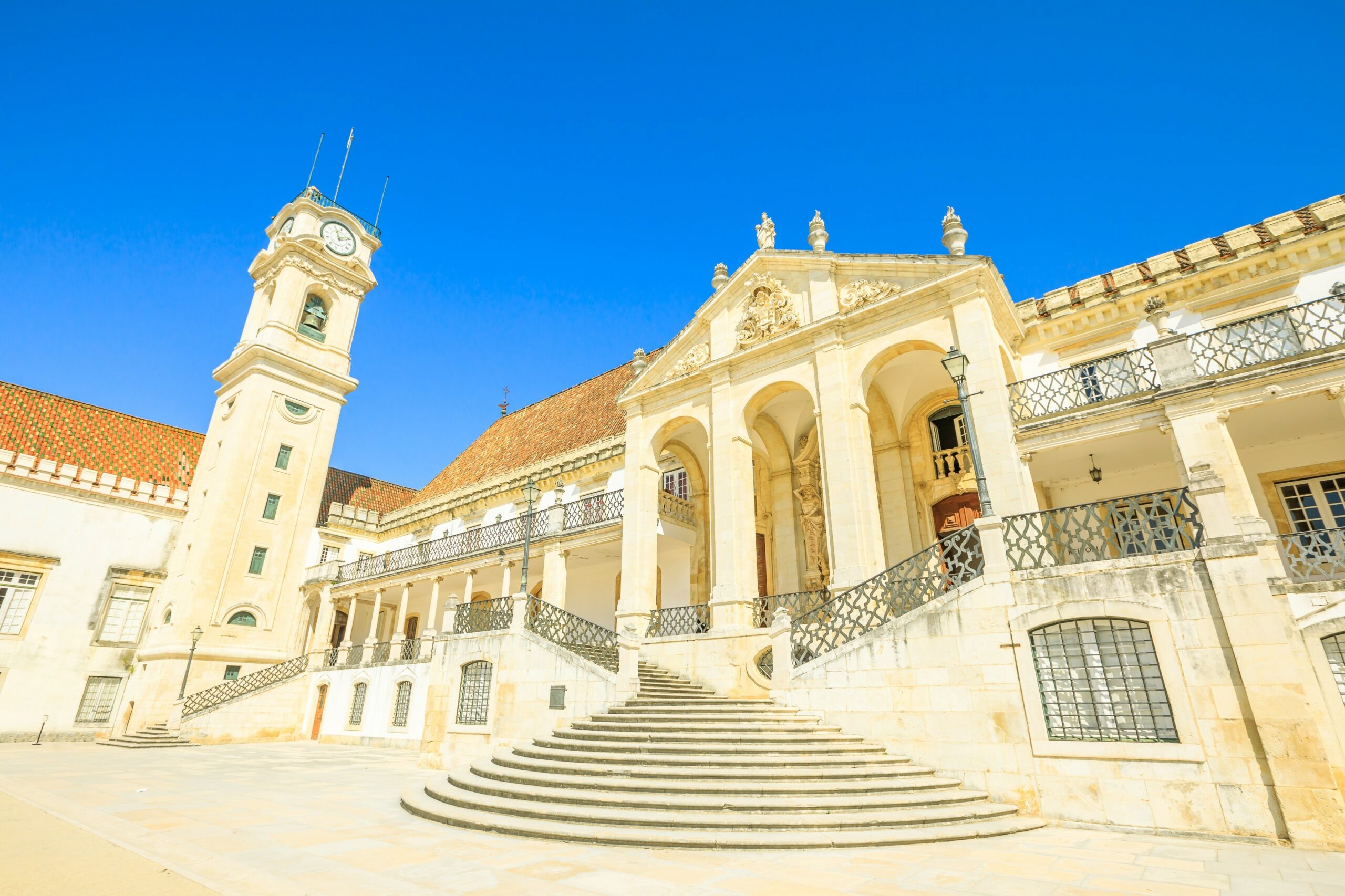
The university’s principal courtyard occupies the former royal palace. The palace rooms, university chapel and library reveal the overlap between monarchy, religion and scholarship. Insider tip: choose your admission according to the interiors you actually want to see; access arrangements and included spaces can change. The courtyard’s Mondego views also help orient you before descending into the old town.
06Rua da Sofia and the former university colleges
Laid out during the 16th-century expansion of university life, this lower-town street gathered religious colleges linked to teaching and study. Its name refers to wisdom, and it forms an important part of the UNESCO property. Insider tip: take this as an architectural walk rather than a sequence of guaranteed interior visits; several historic buildings have other uses or limited access.
07Santa Clara-a-Velha
Across the Mondego, the Gothic monastery associated with Queen Isabel illustrates the city’s long struggle with flooding. Repeated inundation eventually drove the community to the higher Santa Clara-a-Nova in the 17th century. Insider tip: check current access before crossing the river, since conditions and conservation work can affect visits. Its low-lying setting is itself part of the historical explanation.
08Botanical Garden and Science Museum
The Botanical Garden, founded in 1772, and the university’s historic scientific spaces make the Enlightenment reforms visible. The Science Museum occupies the former Laboratorio Chimico, a building closely tied to experimental teaching. Insider tip: garden paths vary in gradient; choose a manageable section rather than assuming the entire garden is a level stroll.
09Conimbriga, near Condeixa-a-Velha
Approximately 16 kilometers southwest of Coimbra, Conimbriga preserves Roman mosaics, houses, baths and defensive walls. It is a separate ancient settlement, not the Roman name for Coimbra. Insider tip: add it only if Roman history is a priority and the day has enough room; the exposed archaeological site deserves unhurried time rather than a rushed stop after every major city monument.
If particular periods interest you—Roman engineering, the first kings or university traditions—ask Portugal Magik for a personalized route that gives those places proper attention.
How a private guided day brings Coimbra’s history to life
A good Coimbra day needs a clear historical thread and a realistic pace. From Lisbon, the road journey is approximately 210 kilometers each way, usually around 2½ hours depending on traffic and pickup location. With roughly five to six hours in Coimbra, this is a full-day outing; adding Conimbriga means reducing time elsewhere or considering a multi-day itinerary.
Portugal Magik offers private day and multi-day tours and private Mercedes-Benz transfers, with door-to-door pickup, an English-speaking driver and flexible itineraries. For smaller groups, a Mercedes-Benz V-Class can be a comfortable option for this journey, subject to availability.
Your Portugal Ambassador—a knowledgeable local English-speaking driver-guide from Portugal—can explain how the Roman town, royal capital and university city fit together, while helping shape the day around your interests and walking comfort. Vehicle access is restricted in parts of the historic center, so a private vehicle reduces the wider travel effort without eliminating walking or steps inside monuments.
One sensible sequence is the university hill first, followed by Sé Velha and the lanes descending toward Santa Cruz. The Machado de Castro Museum works especially well for travelers interested in archaeology; Santa Clara-a-Velha adds the river’s influence and Queen Isabel’s story. A timed Joanina Library visit should anchor the schedule, with current opening arrangements checked before finalizing the route.
Ask for a personalized Coimbra day rather than a checklist of every monument. Established in 2012, Portugal Magik has 1,300+ verified reviews and is consistently five-star rated. Share your starting point, preferred historical themes and walking needs to request a private tour or transfer quote.
Your route
Direct or with stops
Tell us where you would like to pause along the way and we shape the day around it.
Request a proposal →Your pace
One day or several
Spread the journey over a few days with overnight suggestions from our team.
Request a proposal →Your Ambassador
A local by your side
An English-speaking driver-guide from Portugal in a private Mercedes-Benz.
Request a proposal →★★★★★ 1,300+ verified reviews · TripAdvisor Hall of Fame · Since 2012
Keep exploring
Related journeys and routes
The history of the Douro Valley: Wine, Stone and River
The history of the Douro Valley begins long before port wine, with prehistoric engravings, medieval monasteries and generations of work on steep vineyard slopes. Follow the key moments, then discover the places where that past still shapes a visit today.
Read more →The history of Marvão: A Guide to Portugal’s Frontier
The history of Marvão connects a Roman town in the valley with an Islamic rebel leader, medieval kings and centuries of border defence. Understanding those layers turns a walk through its granite lanes into something richer than a castle visit.
Read more →The history of Comporta: Rice, Tides and Coastal Life
The history of Comporta is written in rice fields, fishermen’s jetties and the working landscape of the Sado estuary. Understanding that heritage turns a visit beyond Lisbon into something richer than a day at the beach.
Read more →Frequently Asked Questions
Personalized and without obligation
Speak with a travel designer
1,300+ five-star reviews · TripAdvisor Hall of Fame · Trusted since 2012 · Mercedes-Benz fleet