Top places to visit in Sintra: palaces, gardens and coast
The top places to visit in Sintra range from hilltop royal residences to woodland convents and the Atlantic cliffs beyond town. The secret to enjoying them is choosing a few well, rather than spending the day rushing between entrance gates.
10 top places to visit in Sintra
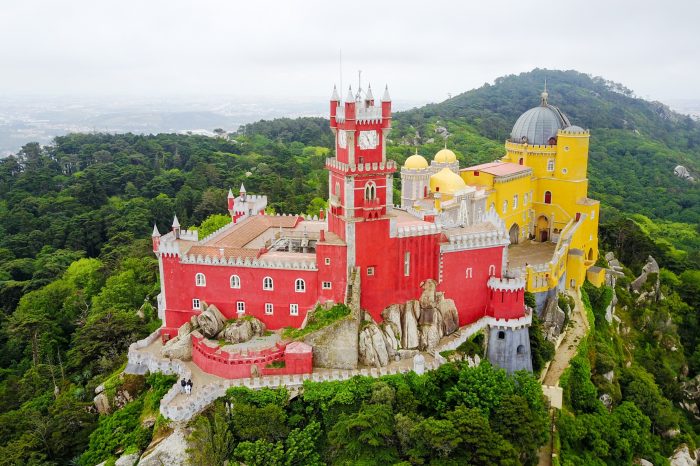
01Park and National Palace of Pena
Created for King Ferdinand II in the 19th century around an earlier monastery, Pena combines vividly colored façades, royal rooms and a sprawling Romantic park on Sintra’s wooded heights. Reserve the appropriate ticket for the palace interior if you want to see the rooms, and distinguish your palace-entry time from your arrival at the park gate: the uphill approach takes additional time. Go early, wear shoes with grip and remember that low cloud can obscure the famous views.
02Castle of the Moors
These medieval fortifications, with origins in the period of Islamic rule, follow a granite ridge above Sintra and offer sweeping views toward the National Palace and the Atlantic on clear days. The exposed walls and uneven steps make this a rewarding but physically demanding stop. Choose a dry, relatively calm day, and allow roughly 90 minutes rather than treating the castle as a quick photo stop beside Pena.
03Quinta da Regaleira
Built for António Augusto Carvalho Monteiro with architect Luigi Manini in the early 20th century, this estate brings together an ornate residence, grottoes, tunnels and the spiral Initiation Well. Its symbolism and unusual garden architecture make it one of the most distinctive Sintra sightseeing stops. Allow around two hours, expect queues at the well and follow the current designated route through its steps and underground passages.
04National Palace of Sintra
The two enormous white kitchen chimneys identify this royal palace at the heart of town, where richly decorated rooms reveal centuries of Portuguese court life. Look for the Swan Room, Magpie Room and the heraldic ceiling and tilework of the Coat of Arms Room. This is a practical choice when you want a substantial historic interior without a hilltop approach, although there are still stairs inside.
05Park and Palace of Monserrate
Associated with the English merchant Francis Cook, who acquired the estate in 1856, Monserrate pairs intricate Gothic, Indian and Moorish-inspired architecture with gardens planted with species from across the world. The palace’s arcaded interiors and the garden’s contrasting landscapes deserve unhurried attention. Allow at least two hours and save energy for the sloping paths; visiting only the palace misses much of the estate’s character.
06Convent of the Capuchos
Founded in 1560, this Franciscan convent replaces royal grandeur with tiny cells, cork-lined surfaces and buildings fitted closely around granite boulders. It offers a striking contrast to Pena and Monserrate, showing how religious austerity shaped life in the Sintra hills. Expect low doorways, uneven ground and damp woodland conditions, and bring an extra layer even when Lisbon feels warm.
07Sintra Historic Centre
The streets around Praça da República and the National Palace are worth exploring for their small shops, traditional pastry counters and views up toward the surrounding hills. Try a travesseiro, a puff-pastry sweet with almond-and-egg filling, at Casa Piriquita, founded in 1862, or seek out Sintra’s traditional cheese-based queijadas. Leave this stop for a proper lunch or pastry break rather than squeezing it into the minutes between timed admissions.
08Chalet and Garden of the Countess of Edla
Built by Ferdinand II and Elise Hensler, Countess of Edla, and completed in 1869, this Alpine-inspired retreat within Pena Park has distinctive cork decoration and a more intimate atmosphere than the main palace. It helps explain the personal side of the royal landscape, beyond Pena’s ceremonial rooms. Check current access arrangements and allow a substantial woodland walk; the chalet is not immediately beside the palace entrance.
09Cabo da Roca
Around 18 kilometers by road west of Sintra town, this headland marks the westernmost point of mainland Europe, with a lighthouse above steep Atlantic cliffs. It belongs to the coastal part of a Sintra itinerary, not the town itself, and works particularly well after a western-hills stop such as Monserrate. Bring a windproof layer, stay behind barriers and skip the detour if fog has removed the views.
10Azenhas do Mar
Around 12 kilometers northwest of Sintra town, this coastal village is known for its white houses stepping down a cliff above a small beach and ocean pool. The familiar view is best appreciated from the viewpoints around the village rather than by expecting a large seaside promenade. Treat it primarily as a scenic stop: stairs are steep, parking is limited, and tides and waves determine whether the beach or pool is suitable for use.
Trusted across Portugal and Spain
Journeys backed by 1,300+ verified reviews
Consistently five-star rated since 2012, Portugal Magik is a TripAdvisor Hall of Fame recipient. Our Portugal Ambassadors bring local knowledge, thoughtful service and dependable private travel to every journey.

Travel with Portugal Magik
Explore Portugal in a Mercedes-Benz V-Class
For smaller groups, a private V-Class offers a comfortable way to travel between places, with an English-speaking driver, door-to-door pickup and a flexible itinerary planned with our team. Vehicle choice depends on your group and availability.
Plan a personalized journey →Combine the sights into a relaxed private route
For one day from Lisbon, choose two major attractions rather than trying to collect every palace. A sensible first visit combines Pena Palace and its immediate surroundings, lunch in Sintra’s historic centre, and Quinta da Regaleira. Allow roughly a full eight-to-ten-hour outing, depending on your starting point, admission times, traffic and walking pace; leave the distant corners of Pena Park for another visit.
If long climbs are not appealing, build the day around the National Palace, a leisurely town-centre lunch and Monserrate. This reduces the emphasis on exposed hilltop walking, although Monserrate’s gardens still have slopes. Ask Portugal Magik for a personalized route based on how much walking your group genuinely enjoys.
With two days, keep Pena, the historic centre and Regaleira together on the first day. Use the second for Monserrate, the Convent of the Capuchos and, if visibility is good, Cabo da Roca. Azenhas do Mar can replace the convent for travelers who prefer a coastal village to another historic interior; it need not become an additional compulsory stop.
To include the National Palace, Castle of the Moors and Countess of Edla’s chalet without rushing, add a third day or swap them for other sights. The castle pairs geographically with Pena, but their combined steps and slopes make for a demanding walking day. The chalet belongs with a longer exploration of Pena Park rather than a separate dash across the hills.
Portugal Magik offers private Mercedes-Benz day and multi-day tours with door-to-door pickup and an English-speaking driver. Your Portugal Ambassador is a knowledgeable local English-speaking driver-guide from Portugal who can provide context and adapt the driving itinerary to conditions. A private Mercedes-Benz V-Class is a comfortable option for smaller groups, subject to availability.
Private transport simplifies the connections between sights, but it does not remove pedestrian approaches, admission queues or road-access restrictions. Your driver uses permitted access and drop-off points; reaching a monument’s entrance may still involve walking. Share your must-see choices and mobility needs when requesting a personalized tour or transfer quote so the proposed route reflects them.
Best time to visit and practical insider tips
April–May and late September–October often offer a good balance of garden interest, daylight and temperatures suited to walking. They are not reliably quiet, especially around Easter, holidays and weekends. July and August tend to bring the strongest demand, while winter can offer a calmer experience but also shorter days, rain, mist and occasional weather-related closures.
Sintra has its own microclimate. The hills may be cool and cloud-covered when Lisbon is sunny, so bring a light waterproof layer and shoes with dependable soles. Pena and the Castle of the Moors are especially exposed; the National Palace offers a more interior-focused alternative when the weather is unsettled.
For the busiest monuments, check official ticket categories, admission slots and opening information before finalizing the route. At Pena, allow time between the park entrance and your scheduled palace admission. Ticket inclusions and permitted access can change, so do not assume that every park ticket includes every interior.
Start with the attraction that matters most to you. An early admission can help, but there is no dependable hour when Pena or Regaleira is empty. Keep a buffer between timed visits and avoid arranging a long lunch immediately before another fixed entry.
Road distance is a poor guide to travel time here. The hills have winding roads, one-way sections and restricted access, while weekends can slow movement around the historic centre. A short line on a map may also conceal a steep walk between an entrance and the building you came to see.
If you are deciding what belongs on a must see Sintra itinerary, prioritize contrasts: one royal palace, one garden estate and time in the old town usually create a more satisfying first visit than several similar interiors. Keep coastal stops conditional on weather and energy, rather than sacrificing the places you most wanted to explore.
Established in 2012, Portugal Magik can help shape these choices into a practical private itinerary. Request a personalized suggestion with your travel dates, starting address and preferred pace.
Your route
Direct or with stops
Tell us where you would like to pause along the way and we shape the day around it.
Request a proposal →Your pace
One day or several
Spread the journey over a few days with overnight suggestions from our team.
Request a proposal →Your Ambassador
A local by your side
An English-speaking driver-guide from Portugal in a private Mercedes-Benz.
Request a proposal →★★★★★ 1,300+ verified reviews · TripAdvisor Hall of Fame · Since 2012
Keep exploring
Related journeys and routes
Your guide to sightseeing in Peneda-Gerês
The best sightseeing in Peneda-Gerês combines granite villages, mountain viewpoints and traces of Roman roads rather than a race between waterfalls. Portugal’s only national park, established in 1971, rewards a carefully paced route with time for short walks and long village lunches.
Read more →Sightseeing in Belmonte: Jewish Heritage, Castles and More
Sightseeing in Belmonte brings together Portugal’s remarkable Jewish heritage, the story of Pedro Álvares Cabral and a hilltop castle overlooking the countryside towards Serra da Estrela. Give this small Beira Interior town time: its museums, granite lanes and living traditions reward a thoughtful visit rather than a hurried stop.
Read more →The top places to visit in Marvão
The top places to visit in Marvão stretch from a granite hilltop castle to Roman ruins in the valley below. This guide connects the village’s essential sights with practical advice for exploring the quieter, higher reaches of Portugal’s Alentejo.
Read more →Frequently Asked Questions
Personalized and without obligation
Speak with a travel designer
1,300+ five-star reviews · TripAdvisor Hall of Fame · Trusted since 2012 · Mercedes-Benz fleet