A local-minded guide to sightseeing in Óbidos
The pleasure of sightseeing in Óbidos lies in its small details: blue-and-white tiles above a gateway, book-lined church interiors and narrow lanes beneath medieval walls. Give this compact town several unhurried hours, rather than treating it as a quick castle photograph.
10 places to include when sightseeing in Óbidos
01Porta da Vila
The main southern gateway introduces Óbidos with an unusual surprise: an interior chapel and an upper gallery decorated with blue-and-white azulejos. The eighteenth-century tiles are worth a proper look, so step out of the flow of arriving visitors and look upward before continuing into town.
02Rua Direita
This principal street connects the entrance area with the castle end of town, passing whitewashed façades, shops and inviting side lanes. It is also an easy place to try ginjinha de Óbidos, the local sour-cherry liqueur; ask for a small tasting, and remember that the chocolate cup is optional rather than essential to the experience.
03Igreja de Santa Maria
Overlooking the town’s main square, this church brings together painted decoration, historic tiles and works by seventeenth-century artist Josefa de Óbidos. Visit outside religious services, and allow your eyes time to adjust before looking closely at the paintings rather than stopping only at the doorway.
04Pelourinho de Óbidos
The sixteenth-century pillory in the square beside Santa Maria is a reminder of the town’s historic municipal authority and administration of justice. Its position makes it one of the easiest Óbidos landmarks to overlook: pause here to take in the relationship between the church, square and surrounding houses.
05Castelo de Óbidos
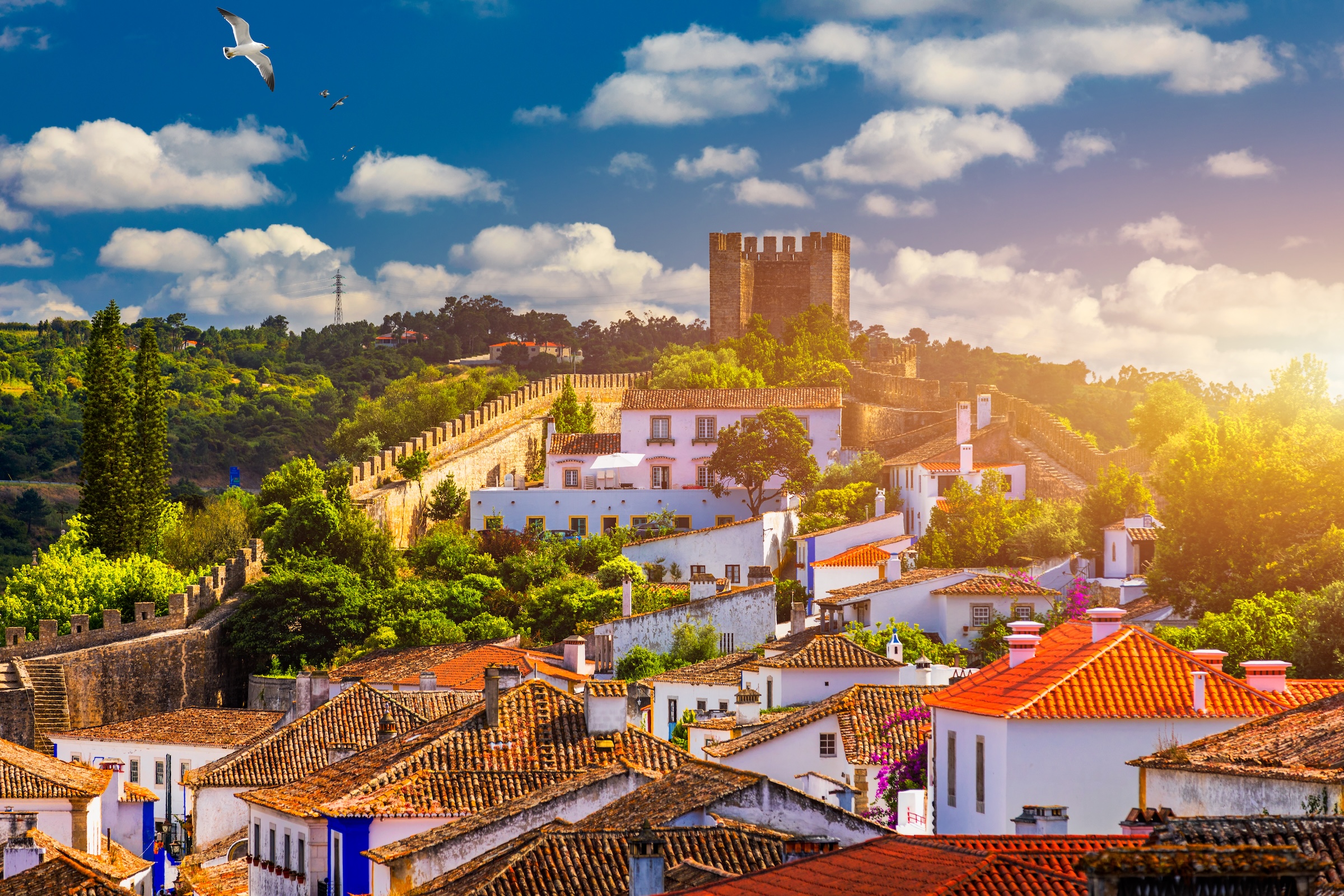
The medieval castle anchors the northern end of the walled town, its towers rising above roofs and countryside. Part of the complex houses a pousada hotel, so do not assume the interior operates as a conventional visitor attraction; concentrate on the exterior and publicly accessible areas, respecting any access restrictions.
06Muralhas de Óbidos
The town walls reveal the compact layout of Óbidos, with terracotta roofs on one side and agricultural land on the other. Many stretches have uneven steps, exposed edges and no protective railing, so choose only a short section if conditions and your confidence allow; the town is rewarding without walking the ramparts.
07Livraria de Santiago
At the castle end of Rua Direita, the former Church of São Tiago now serves as a bookshop and cultural space, making it a distinctive expression of Óbidos’s literary identity. The church was rebuilt after the 1755 earthquake; check current opening hours and events before relying on an interior visit.
08Museu Municipal de Óbidos
The municipal museum adds context to the town’s artistic heritage, including work by Josefa de Óbidos, who lived from 1630 to 1684. It is a worthwhile counterpoint to the busy shopping street, but check current opening arrangements and exhibitions before building your visit around a particular work.
09Aqueduto de Óbidos
Outside the walls, this sixteenth-century aqueduct was commissioned by Queen Catherine of Austria to supply the town with water. Its surviving arches are easiest to appreciate on your approach or departure, so ask your driver to include a suitable stopping point rather than making an unnecessary return walk from the castle.
10Santuário do Senhor Jesus da Pedra
This eighteenth-century sanctuary stands outside the walled town and is distinguished by its unusual hexagonal plan. Include it as a separate stop before entering or after leaving Óbidos, and check opening hours if you want to see the interior rather than simply admire its striking exterior.
Trusted across Portugal and Spain
Journeys backed by 1,300+ verified reviews
Consistently five-star rated since 2012, Portugal Magik is a TripAdvisor Hall of Fame recipient. Our Portugal Ambassadors bring local knowledge, thoughtful service and dependable private travel to every journey.

Travel with Portugal Magik
Explore Portugal in a Mercedes-Benz V-Class
For smaller groups, a private V-Class offers a comfortable way to travel between places, with an English-speaking driver, door-to-door pickup and a flexible itinerary planned with our team. Vehicle choice depends on your group and availability.
Plan a personalized journey →
A relaxed private day from Lisbon—or a two-day route
Óbidos is roughly 85–90 kilometres north of central Lisbon, usually around 75–90 minutes by road, depending on your pickup point and traffic. For a relaxed Óbidos private tour, leave Lisbon early enough to reach the town before the busiest late-morning arrivals, without turning the day into a race.
A comfortable sequence begins with a look at the aqueduct, followed by a drop-off at a permitted access point outside the historic centre. Enter through Porta da Vila, follow Rua Direita to Santa Maria and the pillory, then continue toward the castle and Livraria de Santiago. Add the municipal museum if art interests you, or trade it for time in the side lanes. Walking the walls should remain optional, not the measure of a successful visit.
Allow approximately four to five hours in and around town, including lunch. A restaurant meal and a leisurely walk back through quieter streets make better use of the afternoon than squeezing in every possible stop. Visit Senhor Jesus da Pedra before the return journey, subject to its opening hours and your interests.
Portugal Magik provides private day and multi-day tours with an English-speaking driver, door-to-door pickup and flexible itineraries. Your Portugal Ambassador—a knowledgeable local English-speaking driver-guide from Portugal—can explain the region’s context and help organize sensible stops, while the lanes inside Óbidos are explored on foot. For smaller groups, a private Mercedes-Benz V-Class is a comfortable option for the Lisbon journey, subject to availability. Ask for a personalized route that balances walking, lunch and time to browse.
For a two-day journey, give Óbidos the first day and overnight in Óbidos or nearby. On day two, continue to Alcobaça for its monastery, then to coastal Nazaré for lunch and the views from Sítio before returning to Lisbon. This is a practical mainland route; keeping Alcobaça and Nazaré for a separate day avoids reducing Óbidos to a hurried stop.
Established in 2012, Portugal Magik has 1,300+ verified reviews. If you already have accommodation arranged, request a personalized private transfer quote or discuss a multi-day itinerary with sightseeing stops.
Best time to visit and practical insider tips
April to June and September to October often offer a pleasant balance of temperatures and daylight for exploring Óbidos. Weather remains variable, so bring a light layer and check the forecast. July and August can be hot and busy; an earlier arrival makes the exposed streets and castle area more comfortable.
Winter can suit visitors who prefer a quieter atmosphere, but rain makes the cobbles and wall steps slippery. The town’s Christmas event can also bring substantial crowds, so winter does not always mean empty streets.
Check the current dates of the International Chocolate Festival, Mercado Medieval and FOLIO literary festival before choosing your day. These events can be a reason to visit in their own right, but they also affect crowds, access and the atmosphere of the historic centre. Do not assume dates repeat exactly from one year to the next.
Wear shoes with a firm grip. Óbidos is compact, but sloping cobbles, steps and narrow passages can be tiring for visitors with limited mobility. Tell Portugal Magik about walking preferences when requesting your itinerary so that arrival points, breaks and the amount of sightseeing can be planned realistically; vehicle access within the walls is restricted.
For photographs with fewer people, explore the lanes branching off Rua Direita rather than waiting for the main street to empty. Early morning and late afternoon usually provide gentler light, while the square around Santa Maria is a good place to pause and appreciate the town beyond its shopfronts.
Churches, the museum and bookshops may have different opening schedules, and religious services take priority in active places of worship. Keep one or two interior visits as flexible options, carry water in warmer weather and leave room for lunch rather than relying on snacks and ginjinha alone.
Your route
Direct or with stops
Tell us where you would like to pause along the way and we shape the day around it.
Request a proposal →Your pace
One day or several
Spread the journey over a few days with overnight suggestions from our team.
Request a proposal →Your Ambassador
A local by your side
An English-speaking driver-guide from Portugal in a private Mercedes-Benz.
Request a proposal →★★★★★ 1,300+ verified reviews · TripAdvisor Hall of Fame · Since 2012
Keep exploring
Related journeys and routes
10 things you can't miss in Portugal
These 10 things you can't miss in Portugal connect Lisbon's maritime monuments with royal palaces, medieval towns, vineyard terraces and the Algarve coast. This mainland Portugal travel guide explains what makes each stop worthwhile, when to go and how to combine them without turning your holiday into a checklist.
Read more →10 things you can't miss in Fátima
These 10 things you can't miss in Fátima connect the great sanctuary with the village homes and quiet walking paths behind its story. Whether you come on pilgrimage or to understand an important chapter of Portuguese history, leave time for reflection rather than rushing between monuments.
Read more →A local guide to sightseeing in Amarante
Sightseeing in Amarante brings together the River Tâmega, richly decorated churches and an artistic heritage that rewards a slower visit. Allow time for the bridge, a museum and a pastry stop rather than treating this northern Portuguese town as a quick photograph between Porto and the Douro.
Read more →Frequently Asked Questions
Personalized and without obligation
Speak with a travel designer
1,300+ five-star reviews · TripAdvisor Hall of Fame · Trusted since 2012 · Mercedes-Benz fleet