The history of Tomar: From Templar Stronghold to Living City
The history of Tomar unfolds between a fortified hilltop, the churches and former Jewish quarter below, and an aqueduct stretching across the countryside. Understanding how these places connect turns a visit into something richer than a tour of the Convent of Christ alone.
The history of Tomar in 11 key moments
Tomar stands beside the River Nabão, approximately 140 km by road northeast of Lisbon. Its defining story begins with the medieval kingdom of Portugal, but it continues through maritime expansion, religious upheaval and the changing fortunes of its great monastic estate.
01The Templars establish Tomar (1160–1162)
Gualdim Pais, master of the Knights Templar in Portugal, founded Tomar Castle in 1160. The fortress helped defend territory in the expanding Portuguese kingdom, while the settlement below received a charter in 1162. The fortified hilltop and riverside town developed as complementary parts of the same project: military security above, trade and everyday life below. Insider tip: begin outside the castle walls before entering the convent; the elevated position makes the original defensive logic immediately clear.
02The castle withstands an Almohad siege (1190)
An Almohad army advancing into Portuguese territory besieged Tomar, but the Templar castle held. This episode explains why Tomar mattered beyond its immediate surroundings: it belonged to a network of strongholds protecting routes and settlements in central Portugal. Insider tip: pay attention to the approach to the gates and the changes in ground level, rather than looking only at the battlements; the terrain was part of the defence.
03The Order of Christ succeeds the Templars (1312–1357)
Pope Clement V suppressed the Knights Templar in 1312. King Dinis subsequently secured papal approval for the Order of Christ in 1319, allowing former Templar possessions in Portugal to pass to the new institution. Its first headquarters were at Castro Marim, in the Algarve, before moving to Tomar in 1357. Insider tip: keep the two orders distinct as you visit; much of the convent visible today belongs to the Order of Christ, not to the original Templars.
04Prince Henry leads the Order of Christ (1420–1460)
Prince Henry the Navigator became governor and administrator of the order in 1420. Its resources helped support Portuguese maritime expansion, while Tomar’s religious complex grew around the older Templar church. The Cemetery and Washing cloisters belong to this fifteenth-century phase. Insider tip: compare their relatively restrained Gothic architecture with the more elaborate Renaissance spaces elsewhere in the convent; the contrast reveals successive building campaigns.
05A Jewish community leaves its architectural trace (15th century–1497)
Tomar’s surviving synagogue was built in the fifteenth century, testimony to an established Jewish community in the town. Manuel I’s expulsion decree of 1496, followed by forced conversions in 1497, ended its original use as a synagogue. Its survival gives this difficult chapter a tangible setting beyond royal and military monuments. Insider tip: look for the four central columns and vaulted ceiling; the modest street frontage gives little indication of the interior.
06Manueline builders transform the convent (c. 1510–1515)
Under Manuel I, a new nave and chapter-house structure extended the medieval church. Diogo de Arruda’s celebrated Chapter House window, generally dated to 1510–1513, combines carved ropes, vegetal forms and royal and religious emblems. It belongs to a period when architecture expressed the wealth and ambitions of the Portuguese crown. Insider tip: leave time for the window’s individual details, but avoid assuming every carved shape has one universally agreed symbolic meaning.
07João III reshapes monastic life (1529–1557)
Reform under João III changed the convent’s religious discipline and prompted extensive new construction. Architect João de Castilho played a central role in creating the Renaissance convent, with accommodation, service spaces and cloisters reflecting a more enclosed communal life. The main cloister continued to evolve through later work by Diogo de Torralva. Insider tip: notice how the complex shifts from the compact medieval church to long corridors and ordered courtyards; this is institutional reform expressed through buildings.
08The Cortes meet in Tomar (1581)
The Cortes assembled at the Convent of Christ and acclaimed Philip II of Spain as Philip I of Portugal. This consolidated the dynastic union of the Portuguese and Spanish crowns, which lasted until 1640. Portugal retained separate laws and institutions, so the event should not be reduced to a simple disappearance of the Portuguese state. Insider tip: remember this political chapter while visiting the convent; its importance extended well beyond the religious order living there.
09The Pegões Aqueduct supplies the convent (1593–1614)
Construction of the Pegões Aqueduct began in 1593 and was completed in 1614. Associated with engineer Filipe Terzi and later Pedro Fernandes de Torres, the roughly six-kilometre system carried water to the convent. Its monumental arches reveal the practical infrastructure required to sustain a large religious community. Insider tip: include the tall, two-tiered valley crossing if your itinerary allows; isolated views of smaller arches do not convey the scale of the undertaking.
10The religious orders are dissolved (1834)
Portugal’s suppression of male religious orders ended the convent’s traditional monastic occupation. Buildings, land and possessions entered new patterns of state and private ownership, beginning a different phase in the site’s history. The monument visitors encounter today is therefore not an institution preserved unchanged from the Middle Ages. Insider tip: read the room labels as evidence of former daily routines; dormitories, kitchens and service areas help recover the community behind the grand architecture.
11The Convent of Christ gains UNESCO recognition (1983)
UNESCO inscribed the Convent of Christ in Tomar on the World Heritage List in 1983. Its significance lies partly in the extraordinary sequence of Romanesque, Gothic, Manueline and Renaissance architecture contained within one complex. Insider tip: identify at least one feature from each major period rather than searching for a single consistent style; the layers are precisely what make the monument important.
Plan with confidence
Plans change. Your options are clear.
Change dates without an extra change charge when available, and cancel early for a refund or travel credit. Our team confirms every detail before you pay.

Travel with Portugal Magik
Explore Portugal in a Mercedes-Benz V-Class
For smaller groups, a private V-Class offers a comfortable way to travel between places, with an English-speaking driver, door-to-door pickup and a flexible itinerary planned with our team. Vehicle choice depends on your group and availability.
Plan a personalized journey →Where Tomar’s history can still be seen today
These are the historic sites Tomar is best known for, together with places that explain the town beyond its hilltop monument. The lower centre is relatively compact, but the convent requires an uphill approach and Pegões is a separate countryside stop.
01Tomar Castle and the Convent of Christ
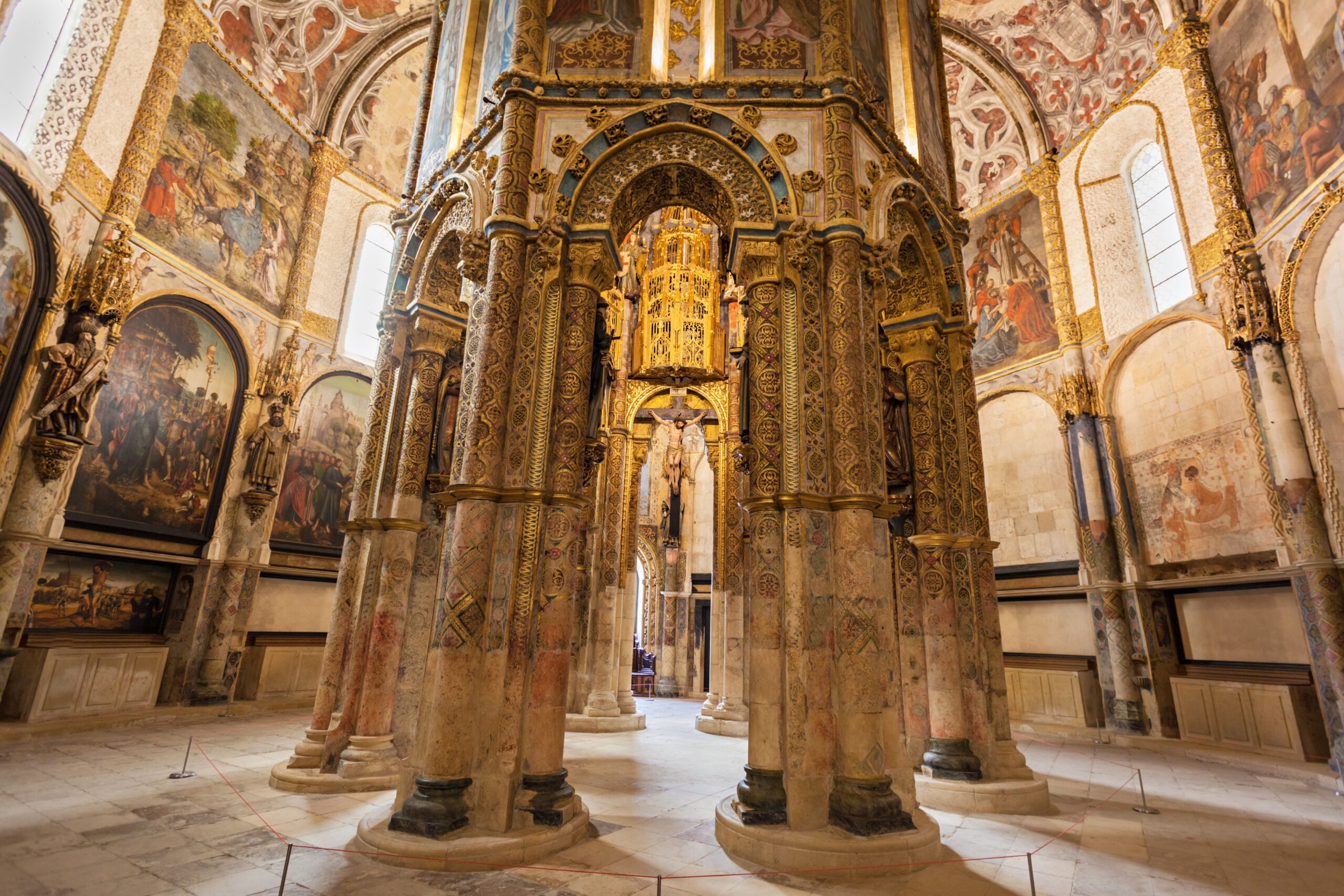
The essential starting point combines the Templar fortress begun in 1160 with centuries of additions by the Order of Christ. Inside, the Charola preserves the form of the medieval round church, although much of its rich painted and sculpted decoration is later. The Manueline window and Renaissance cloisters show how dramatically the complex developed. Allow around two to three hours if you enjoy architecture and want time to pause. Insider tip: see the Charola and later church as connected but historically distinct spaces; this prevents the common mistake of calling everything Templar.
02Church of Santa Maria do Olival
About one kilometre southeast of Praça da República, this church was closely associated with the Templars and served as a burial place for members of the order. Its surviving medieval architecture is largely thirteenth-century, and a funerary inscription commemorates Gualdim Pais, who died in 1195. It offers a quieter counterpart to the fortified hilltop. Insider tip: notice the separate bell tower and the rose window before entering; the exterior deserves more than a quick photograph from the roadside.
03Tomar Synagogue
On Rua Dr. Joaquim Jacinto, the fifteenth-century synagogue preserves a rare medieval Jewish worship space. Its four central columns support a compact vaulted room, bringing the story of Tomar’s Jewish community into sharp focus. This is a place to consider both community life and the rupture caused by forced conversion. Insider tip: check current opening arrangements before fixing your schedule; it is a small site, not a monument to assume will always be accessible between other stops.
04Church of São João Baptista and Praça da República
The late-fifteenth-century church anchors Tomar’s principal square, opposite the town hall and beside the statue of Gualdim Pais. Its Manueline portal links the civic centre visually with the period of expansion at the convent. Inside are paintings associated with the sixteenth-century artist Gregório Lopes, subject to current display and access. Insider tip: stand near the statue and look uphill towards the castle; few viewpoints explain the relationship between the town and its fortress so neatly.
05Pegões Aqueduct
The best-known monumental stretch lies roughly four kilometres from central Tomar. Built between 1593 and 1614, the aqueduct supplied the convent from springs outside the town, crossing uneven ground with increasingly tall arcades. It makes an excellent final historical stop because it answers a question visitors often overlook: how was this enormous complex supplied with water? Insider tip: enjoy the structure from ground level; the elevated channel is not necessary for a rewarding visit and is unsuitable for anyone uncomfortable with heights or exposed edges.
06Mata Nacional dos Sete Montes
Below the convent, this approximately 39-hectare woodland preserves part of the landscape historically associated with the religious complex. Its paths provide a different perspective on monastic space: not only churches and cloisters, but managed land beyond them. The small circular structure known as the Charolinha is a distinctive feature within the grounds. Insider tip: treat a woodland walk as an optional addition rather than a shortcut; reaching the Charolinha takes extra time, and woodland access can be affected by weather or fire-risk restrictions.
For a first visit, prioritize the convent, the lower town and one additional stop that matches your interests. Ask Portugal Magik for a personalized itinerary if you would like to balance Templar history, Jewish heritage and architectural detail without rushing between them.
Bring Tomar history to life on a private day tour
Tomar rewards a day built around connections rather than a long checklist. From Lisbon, the journey is approximately 140 km by road, usually around one hour and forty minutes to two hours each way, depending on your pickup point and traffic. A dedicated Tomar day gives the town more breathing room than an itinerary combining several major destinations.
Portugal Magik offers private day and multi-day tours and private Mercedes-Benz transfers, with an English-speaking driver, door-to-door pickup and flexible itineraries. For couples, families and smaller groups, a Mercedes-Benz V-Class can be a comfortable option for the Lisbon–Tomar journey, subject to availability.
A sensible sequence begins at the Convent of Christ, allowing two to three hours for the castle setting, Charola, Manueline details and cloisters. Continue into the lower town for lunch and a walk linking Praça da República with the former Jewish quarter. Depending on your interests, opening hours and energy, finish with Santa Maria do Olival or the Pegões Aqueduct.
The value of a thoughtfully arranged day is continuity: the castle explains the Templar foundation, the synagogue introduces a different community’s history, and the aqueduct reveals the practical demands of the later convent. Your driver can help coordinate the route and timing, while you explore the monuments at your own pace. An English-speaking driver should not be confused with an included specialist guide inside every monument; clarify any interior-guiding requirements when requesting your quote.
Tell Portugal Magik which chapter interests you most, and ask for a personalized private tour proposal. If you already have your visits arranged, request a private transfer quote instead. Mention any mobility concerns in advance: the convent is extensive, with uneven surfaces, steps and substantial walking, and a vehicle transfer cannot remove every access challenge.