The history of Monsaraz: A Guide to Its Past and Places
The history of Monsaraz stretches from prehistoric communities on the Alentejo plains to a fortified medieval town overlooking the Guadiana frontier. Follow its story through surviving gateways, a remarkable courtroom painting and streets whose importance once reached far beyond their walls.
The history of Monsaraz in 10 key moments
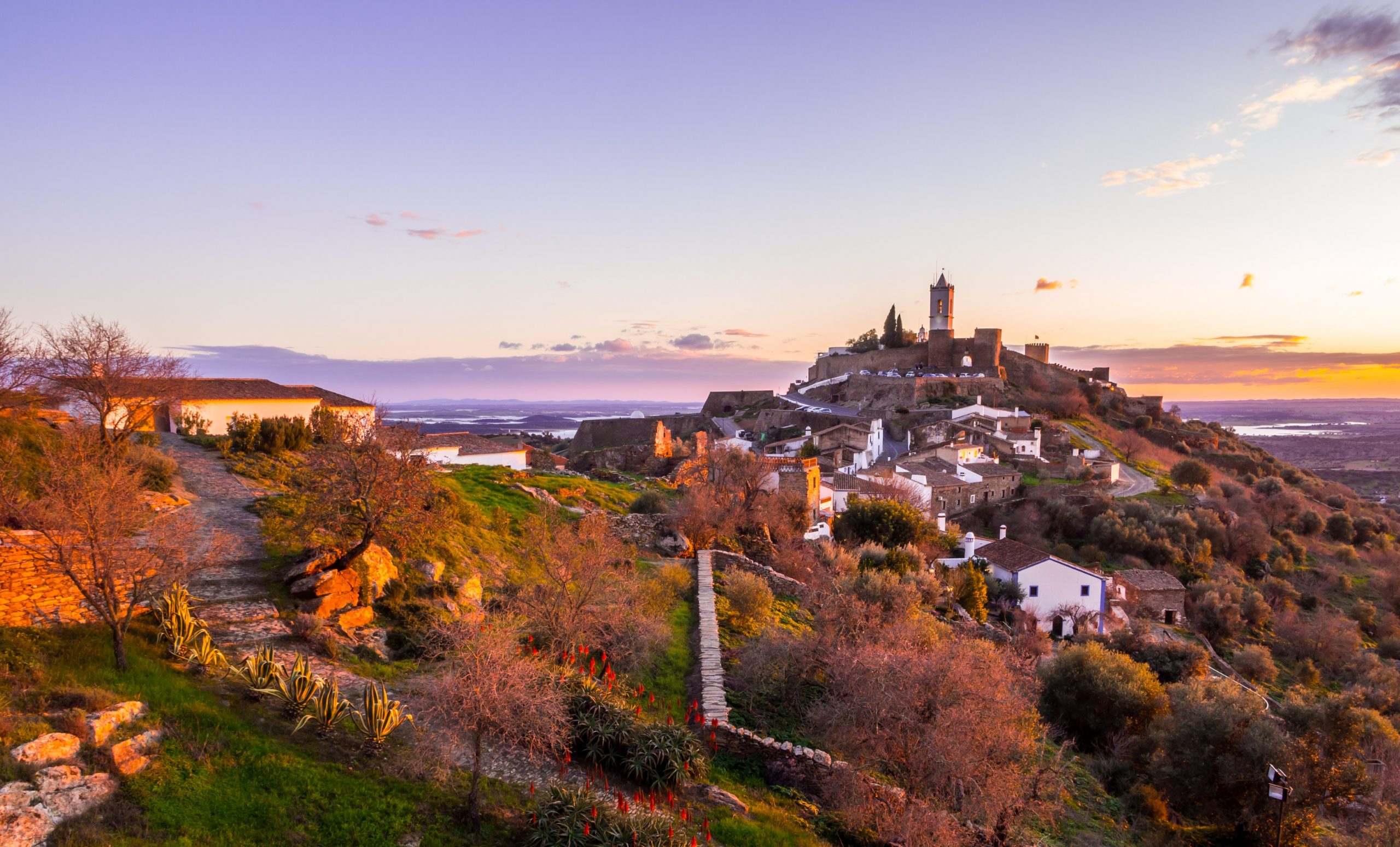
Monsaraz is a small hilltop settlement in the municipality of Reguengos de Monsaraz, eastern Alentejo. Its compact appearance can be misleading: the surrounding landscape preserves thousands of years of human activity, while the walled town reflects successive struggles over land, borders and local authority.
01Prehistoric communities and standing stones (fourth–third millennia BC)
Long before the medieval town developed, communities in the surrounding countryside erected megalithic monuments. The menhirs of Outeiro and Bulhoa and the stones of the Xerez cromlech belong to this much older landscape. Their presence should not be confused with proof that the present hilltop village was continuously occupied from that period. Tip: include a countryside stop as well as the walls; otherwise, the earliest chapter of Monsaraz history remains largely out of sight.
02Islamic rule in the Guadiana region (eighth–early thirteenth centuries)
Following the Muslim conquest of much of the Iberian Peninsula, this region became part of al-Andalus. Monsaraz's elevated position made it valuable for observing routes and surrounding territory. The fabric visible today, however, is largely the result of later rebuilding, so it would be misleading to label the entire surviving castle Moorish. Tip: use the hilltop panorama to understand the strategic location rather than expecting an intact Islamic monument.
03The capture associated with Geraldo Sem Pavor (1167)
Monsaraz was taken for the Portuguese side during the campaigns of Afonso Henriques, in an episode associated with Geraldo Sem Pavor, or Gerald the Fearless. This was not the final change of control: subsequent Muslim recovery shows how unsettled the frontier remained. Tip: remember the distinction between the first Portuguese capture and the definitive conquest; both dates appear in accounts of the town.
04Definitive Portuguese conquest (1232)
Under Sancho II, Monsaraz came definitively under Portuguese rule. Securing such strongholds helped consolidate royal control in the Alentejo, where settlement, defence and the organization of agricultural territory were closely connected. Tip: pause beside a town gateway and consider how a controlled entrance served both military defence and everyday movement between the settlement and its fields.
05A royal charter and stronger defences (1276–early fourteenth century)
Afonso III granted Monsaraz a foral, or municipal charter, in 1276. The castle and defensive enclosure were developed under Afonso III and Dinis, giving architectural form to the town's role as a Portuguese frontier stronghold. Tip: read the castle and the town walls together; the fortress protected a functioning community, not simply an isolated military post.
06Manuel I renews the municipal charter (1512)
The Manueline renewal of Monsaraz's foral formed part of a wider reform of municipal rights, obligations and revenues. This administrative history matters as much as the battles: a charter regulated the relationship between the Crown, the town and its economic life. Tip: around the main square, look for the relationship between religious and civic spaces rather than assuming every monument there dates from the same reign.
07The parish church is rebuilt (sixteenth century)
The present Igreja de Nossa Senhora da Lagoa reflects a sixteenth-century rebuilding of an earlier church. Inside, the medieval tomb of Gomes Martins Silvestre preserves an older layer of local history, demonstrating how monuments could survive major architectural changes. Tip: if the church is open, seek out the tomb rather than treating the building as a single-period interior.
08Fortification for the Restoration Wars (1640–1668)
After Portugal restored its independence from the Spanish monarchy in 1640, frontier defence became urgent. Monsaraz gained seventeenth-century defensive works suited to the age of artillery, complementing its older medieval fortifications. Tip: compare the tall castle walls with the lower, angular defensive forms around the settlement; their different shapes answer different military needs.
09Municipal importance shifts to Reguengos (1851)
After nineteenth-century changes in the location of the municipal seat, its definitive transfer to Reguengos in 1851 marked Monsaraz's loss of administrative primacy. The more accessible settlement below became the centre of municipal life. Tip: do not confuse Monsaraz with Reguengos de Monsaraz when planning a visit; the historic walled village and the municipal town are separate places, roughly 15 km apart by road.
10Alqueva transforms the view (2002 onward)
The closing of the Alqueva Dam's gates in 2002 began the filling of the reservoir that now dominates many views from Monsaraz. The water is a recent addition to a much older frontier landscape, and the project also prompted archaeological work and the relocation of the Xerez cromlech. Tip: when looking from the ramparts, mentally replace the water with the former river valley; medieval defenders saw a very different scene.
Trusted across Portugal and Spain
Journeys backed by 1,300+ verified reviews
Consistently five-star rated since 2012, Portugal Magik is a TripAdvisor Hall of Fame recipient. Our Portugal Ambassadors bring local knowledge, thoughtful service and dependable private travel to every journey.

Travel with Portugal Magik
Explore Portugal in a Mercedes-Benz V-Class
For smaller groups, a private V-Class offers a comfortable way to travel between places, with an English-speaking driver, door-to-door pickup and a flexible itinerary planned with our team. Vehicle choice depends on your group and availability.
Plan a personalized journey →Where Monsaraz history can still be seen today
Among the historic sites Monsaraz preserves, the most revealing are not necessarily the largest. A gateway explains movement and defence; a church tomb records local standing; a painted courtroom wall speaks directly about the responsibilities of power.
01Castelo de Monsaraz
At the southern end of the walled village, the castle is the clearest expression of Monsaraz's medieval defensive role. Its keep and enclosure reward close attention before you turn to the views across the Alqueva reservoir and towards Spain. The enclosure later acquired an additional use as a bullring, another reminder that old military spaces were adapted rather than simply abandoned. Tip: wear shoes with reliable grip; steps and stone surfaces can be uneven, and exposed viewpoints require care.
02Porta da Vila and Rua Direita
The principal gateway leads into the village's compact street network. Its pointed arch, associated towers and position within the walls help explain how entry into a fortified town was managed. Continue along Rua Direita to connect the entrance with the central civic and religious spaces. Tip: stop just outside the gateway first; from inside alone, it is easier to miss how the entrance relates to the defensive enclosure.
03Igreja de Nossa Senhora da Lagoa
The parish church stands on Largo Dom Nuno Álvares Pereira, the village's main square. Its interior contains the Gothic tomb of Gomes Martins Silvestre, a prominent local figure, with a carved funeral procession that offers a more personal encounter with medieval society than the military monuments do. Tip: check access locally and keep visits discreet during worship; an open square does not necessarily mean the church interior is open.
04Former courthouse and the Good and Bad Judge fresco
The former Paços da Audiência contains one of Monsaraz's most distinctive historical works: the fresco known as O Bom e o Mau Juiz. Its contrasting judges turn an abstract subject—justice and corruption—into a visual lesson within a setting where judgments were actually delivered. Tip: allow time to examine the figures and their gestures rather than making this a quick photograph stop; confirm current opening arrangements before building the day around interior access.
05The walls and seventeenth-century defensive works
Walking beside the walls reveals that Monsaraz was fortified in more than one era. The medieval enclosure and later artillery-era additions belong to different military worlds. Their relationship is especially useful for understanding why Portuguese border towns continued to change after the Middle Ages. Tip: look outward as well as upward; the ground below the walls helps explain which approaches defenders needed to watch.
06Cromeleque do Xerez
Outside the hilltop village, near the Convento da Orada, this group of standing stones introduces the prehistoric history of the surrounding region. It was relocated in connection with the Alqueva reservoir project, and the arrangement seen today should not be mistaken for an untouched prehistoric setting. Tip: pair the stop with a discussion of archaeological preservation; its modern relocation is an important part of the site's story.
07Menir do Outeiro
In the countryside near Outeiro, this granite standing stone rises approximately 5.6 metres above the ground. It provides a striking sense of the scale of prehistoric monument-building around Monsaraz, well beyond the later castle walls. Tip: ask for this stop to be considered when shaping your itinerary; it requires a separate countryside approach, not a short walk from the village square.
For a visit centred on history rather than a succession of viewpoints, ask Portugal Magik to shape a personalized route around the castle, courthouse and one prehistoric site.
How a private guided day brings the story to life
A rewarding historical visit follows a sequence: the prehistoric landscape below the hill, the fortified settlement above it, and the much more recent reservoir beyond. That order makes Monsaraz easier to understand than an unstructured walk between photo stops.
From Lisbon, allow roughly 180–190 km and around 2 hours 15 minutes to 2 hours 45 minutes each way, depending on your pickup point, traffic and route. This is a full-day journey, not a quick excursion. Évora is approximately 55 km from Monsaraz by road; combining the two is possible, but substantial visits to both make for a longer day. If medieval streets and local history are your priority, give Monsaraz the larger share of your time.
Portugal Magik offers private day and multi-day tours and private Mercedes-Benz transfers with an English-speaking driver, door-to-door pickup and flexible itineraries. Your Portugal Ambassador is a knowledgeable local English-speaking driver-guide from Portugal who can connect the landscape, royal chronology and surviving monuments as the day unfolds. For smaller groups, a private Mercedes-Benz V-Class is a comfortable option for the journey, subject to availability.
A history-focused day could begin with a megalithic stop, continue through Porta da Vila to the main square, and leave generous time for the castle and any accessible interiors. Between visits, allow for lunch: açorda alentejana, typically made with bread, garlic, coriander and olive oil, is one regional dish worth looking for on local menus. Museum and church opening arrangements should be checked when planning; the itinerary should not depend on every interior being accessible.
Tell your Portugal Ambassador whether you prefer medieval military history, prehistoric archaeology or a gentler walk with frequent pauses. Monsaraz has uneven paving, slopes and exposed stretches with little shade, so comfortable footwear, drinking water and a sensible summer schedule make a real difference. Door-to-door pickup simplifies the longer journey, but it does not remove the need to walk within the historic village.
Established in 2012, Portugal Magik has 1,300+ verified reviews, is consistently five-star rated and holds TripAdvisor Hall of Fame recognition. Request a personalized Monsaraz itinerary with your Lisbon pickup location, preferred pace and must-see sites, or ask about including an overnight stay in the Alentejo within a private multi-day tour.
Your route
Direct or with stops
Tell us where you would like to pause along the way and we shape the day around it.
Request a proposal →Your pace
One day or several
Spread the journey over a few days with overnight suggestions from our team.
Request a proposal →Your Ambassador
A local by your side
An English-speaking driver-guide from Portugal in a private Mercedes-Benz.
Request a proposal →★★★★★ 1,300+ verified reviews · TripAdvisor Hall of Fame · Since 2012
Keep exploring
Related journeys and routes
The history of Lagos: a guide to its past and places
The history of Lagos connects an Algarve harbour with medieval conquest, Atlantic exploration, the trade in enslaved Africans and the earthquake of 1755. Follow that story through the old town’s walls, waterfront monuments and museums, with time to understand what survives—and what has been rebuilt.
Read more →The history of Guimarães: Portugal’s Beginnings and Beyond
The history of Guimarães connects a powerful medieval countess, a decisive battle and the rise of Portugal’s first king with streets you can still explore today. Beyond the castle, its squares, former leather-working district and archaeological collections reveal a city shaped by far more than its royal beginnings.
Read more →The history of Évora: a guide to the city’s living past
The history of Évora unfolds through Roman columns, medieval lanes, royal foundations and university courtyards. This guide connects the key dates with the places you can still explore, helping you understand the city rather than simply photograph its monuments.
Read more →Frequently Asked Questions
Personalized and without obligation
Speak with a travel designer
1,300+ five-star reviews · TripAdvisor Hall of Fame · Trusted since 2012 · Mercedes-Benz fleet