The history of Sintra: From Moorish Walls to Royal Palaces
The history of Sintra unfolds across granite ridges, medieval courtyards and gardens planted with trees from distant continents. Around 30 km northwest of Lisbon, this former royal retreat rewards visitors who look beyond the palace façades to understand who built them, and why.
The history of Sintra in 10 key moments
Sintra was not created in a single royal building campaign. Its distinctive landscape accumulated over centuries, with successive inhabitants adapting the mountain’s defensive heights, water sources and cooler climate to very different purposes.
01Roman settlement and sacred landscapes (1st century BC–5th century AD)
Sintra’s Roman past survives in inscriptions, funerary monuments and traces of rural estates. At Alto da Vigia, near Praia das Maçãs, inscriptions attest to a sanctuary associated with the Sun, Moon and imperial cult. Insider tip: the Archaeological Museum of São Miguel de Odrinhas offers a more substantial introduction to this era than the palace circuit does.
02Islamic Sintra and the hilltop fortress (8th–12th centuries)
Sintra developed within Muslim-ruled western Iberia, and the Moorish Castle’s origins are generally dated to the 10th century. Its ridge-top position helped control the surrounding territory and approaches to Lisbon. Insider tip: look at the relationship between the walls and the enormous granite boulders; the builders made the mountain itself part of the defences.
03Christian conquest and a royal charter (1147–1154)
Sintra passed into the hands of Afonso Henriques in 1147, during the expansion of the Portuguese kingdom that also brought Lisbon under his control. In 1154, he granted Sintra a foral, a charter regulating local rights and obligations. Insider tip: distinguish the castle’s Islamic origins from the Christian occupation and later restoration visible today.
04A royal residence takes shape (14th–16th centuries)
The Sintra National Palace developed from an earlier residence into a favoured royal retreat. Major works under João I and Manuel I produced much of the complex visitors recognise, including its extraordinary kitchens, ceremonial rooms and Manueline details. Insider tip: visit the kitchens as well as the decorated halls; they explain the purpose of Sintra’s two unmistakable white chimneys.
05The Lisbon earthquake reaches Sintra (1755)
The earthquake of 1 November damaged buildings in Sintra, including the royal palace and the monastery on the site of today’s Pena Palace. Subsequent repairs became another layer in the town’s architectural history. Insider tip: do not read every palace room as untouched medieval fabric; Sintra’s monuments contain centuries of rebuilding and adaptation.
06Ferdinand II creates Pena Palace (1838–1854)
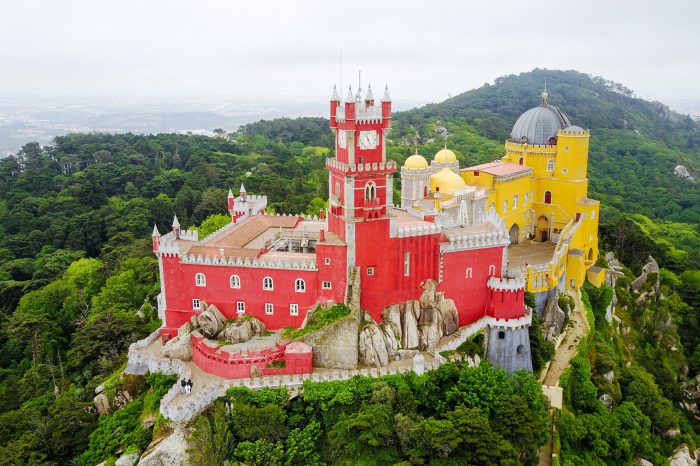
Ferdinand II acquired the former Hieronymite monastery of Nossa Senhora da Pena in 1838 and transformed it into a royal summer residence. The project combined surviving monastic buildings with an exuberant Romantic palace and an extensive landscaped park. Insider tip: pay attention to the old cloister; it makes the earlier monastery easier to recognise beneath the 19th-century transformation.
07Monserrate’s Victorian reinvention (1856–1860s)
British merchant Francis Cook acquired Monserrate in 1856. Architect James Knowles Jr designed its new palace, while the estate became celebrated for gardens combining plants from different parts of the world. Insider tip: allow time for the grounds, not just the house; the planting is central to understanding this chapter of Sintra history.
08Quinta da Regaleira becomes a symbolic estate (1892–1910)
António Augusto Carvalho Monteiro purchased Quinta da Regaleira in 1892. Working with Italian architect and stage designer Luigi Manini, he developed its palace, chapel and elaborate gardens, with major construction taking place between 1904 and 1910. Insider tip: see the chapel and palace alongside the Initiation Well; focusing only on the famous staircase misses the estate’s wider design.
09The monarchy ends (1910)
Portugal became a republic on 5 October 1910, ending the royal world that had shaped both Pena and the National Palace. These residences subsequently became places where visitors could encounter the material history of the monarchy. Insider tip: at Pena, the furnished rooms help connect the fantastical exterior to the comparatively recent lives of its last royal occupants.
10Sintra becomes a World Heritage cultural landscape (1995)
UNESCO inscribed the Cultural Landscape of Sintra in 1995, recognising the exceptional relationship between Romantic architecture, gardens and the surrounding mountain landscape. The designation is not simply an award for one palace. Insider tip: include a garden walk or a view across the wooded slopes to appreciate why the landscape matters as much as the buildings.
Plan with confidence
Plans change. Your options are clear.
Change dates without an extra change charge when available, and cancel early for a refund or travel credit. Our team confirms every detail before you pay.

Travel with Portugal Magik
Explore Portugal in a Mercedes-Benz V-Class
For smaller groups, a private V-Class offers a comfortable way to travel between places, with an English-speaking driver, door-to-door pickup and a flexible itinerary planned with our team. Vehicle choice depends on your group and availability.
Plan a personalized journey →Where Sintra’s history can still be seen today
The most revealing historic sites in Sintra do different jobs: one explains royal ceremony, another military geography, another the ideas behind Romantic landscape design. Choose a combination rather than expecting every palace to tell the same story.
01Sintra National Palace
In the historic centre, this is the strongest starting point for understanding the town’s long relationship with the Portuguese monarchy. The Swan Room, Magpie Room, Heraldic Hall and monumental kitchens reveal courtly symbolism, decoration and daily logistics. Insider tip: compare the rooms’ ceilings and tilework rather than treating the palace as a single-period building; its layered character is the point.
02Moorish Castle
Above the town, the castle makes Sintra’s strategic geography immediately understandable. Its origins are Islamic, but the site also preserves evidence of Christian occupation and substantial 19th-century restoration associated with Ferdinand II. Insider tip: wear shoes with reliable grip and assess the weather before committing to the exposed wall walks; wet granite and strong winds can change the experience considerably.
03Park and Palace of Pena
Pena is the essential stop for 19th-century Romanticism: a former monastery reimagined as a royal residence, surrounded by a deliberately composed landscape. Its medieval references are largely Romantic interpretations, not evidence that the whole palace is medieval. Insider tip: follow the arrival instructions for your ticket and allow for the uphill route between the park entrance and palace; reaching the gate is not the same as reaching the interior entrance.
04Park and Palace of Monserrate
Roughly 4 km west of Sintra’s historic centre, Monserrate connects the town to British patrons, international architectural influences and botanical collecting. Its arcaded interiors and richly worked decoration reward close attention. Insider tip: leave enough time to follow the garden paths at an unhurried pace; the terrain and planting make a rushed palace-only stop particularly limiting here.
05Quinta da Regaleira
Close to the historic centre, Regaleira represents the imaginative world of a wealthy early-20th-century patron rather than a medieval royal court. The Initiation Well, tunnels, chapel and terraces form a carefully staged landscape. Insider tip: be cautious with confident claims about secret ceremonies; symbolic interpretations are not the same as documentary proof that particular rituals took place.
06Convent of the Capuchos
Founded in 1560, this Franciscan convent offers a striking counterpoint to Sintra’s palaces. Small cells, cork-lined surfaces and buildings fitted among granite rocks express an austere religious life closely connected to the forest. Insider tip: check accessibility before choosing this stop; low doorways, confined rooms and uneven paths are fundamental features of the site, not incidental obstacles.
07Archaeological Museum of São Miguel de Odrinhas
Outside Sintra’s central palace circuit, this museum is especially valuable for Roman inscriptions and the region’s deeper archaeological history. It shows that Sintra’s past extends well beyond royal summer residences. Insider tip: treat it as a deliberate addition to a history-focused itinerary, not a quick detour between hillside monuments.
For a first visit, the National Palace and one contrasting site usually offer more historical depth than a hurried attempt to enter every major attraction. Ask Portugal Magik for a personalized itinerary built around the periods that interest you most.
How a private guided day brings Sintra’s history to life
A well-planned day gives Sintra’s separate monuments a clear narrative. Start with the National Palace to understand the monarchy’s long presence, then choose Pena for Romantic reinvention, the Moorish Castle for military history, or Monserrate for architecture and gardens. Two substantial visits, with time in the historic centre, are a sensible foundation rather than a rigid limit.
Portugal Magik offers private day and multi-day tours with an English-speaking driver, door-to-door pickup and flexible itineraries. From Lisbon, the journey commonly takes around 40–60 minutes, although traffic and the pickup address can change that considerably. A private Mercedes-Benz V-Class is a comfortable option for smaller groups on this journey, subject to availability; vehicle selection should be confirmed when requesting your quote.
Your driver can help connect the day’s stops and manage the road logistics, while you explore the monuments at a realistic pace. A tour with an English-speaking driver should not be assumed to include specialist guiding inside each monument: confirm admission tickets, interior visits and any guiding arrangements before booking.
Sintra’s steep terrain, controlled vehicle access and timed admissions make sequencing important. Door-to-door pickup does not remove the uphill walks or steps within historic estates. Share any mobility concerns in advance, and ask for an itinerary that reflects how much walking you actually enjoy.
For a more focused day, request a royal-history route pairing the National Palace with Pena, or a landscape-history route combining Monserrate with the Convent of the Capuchos. If you are staying in Sintra rather than visiting for the day, ask Portugal Magik for a personalized private Mercedes-Benz transfer quote instead.