The history of Óbidos: Queens, Castle Walls and Living Heritage
The history of Óbidos stretches beyond its familiar castle walls, connecting Roman settlement, Islamic rule and centuries of royal patronage. Follow that story through the town’s gateways, churches and streets, with practical advice on what to look for today.
The history of Óbidos in 10 key moments
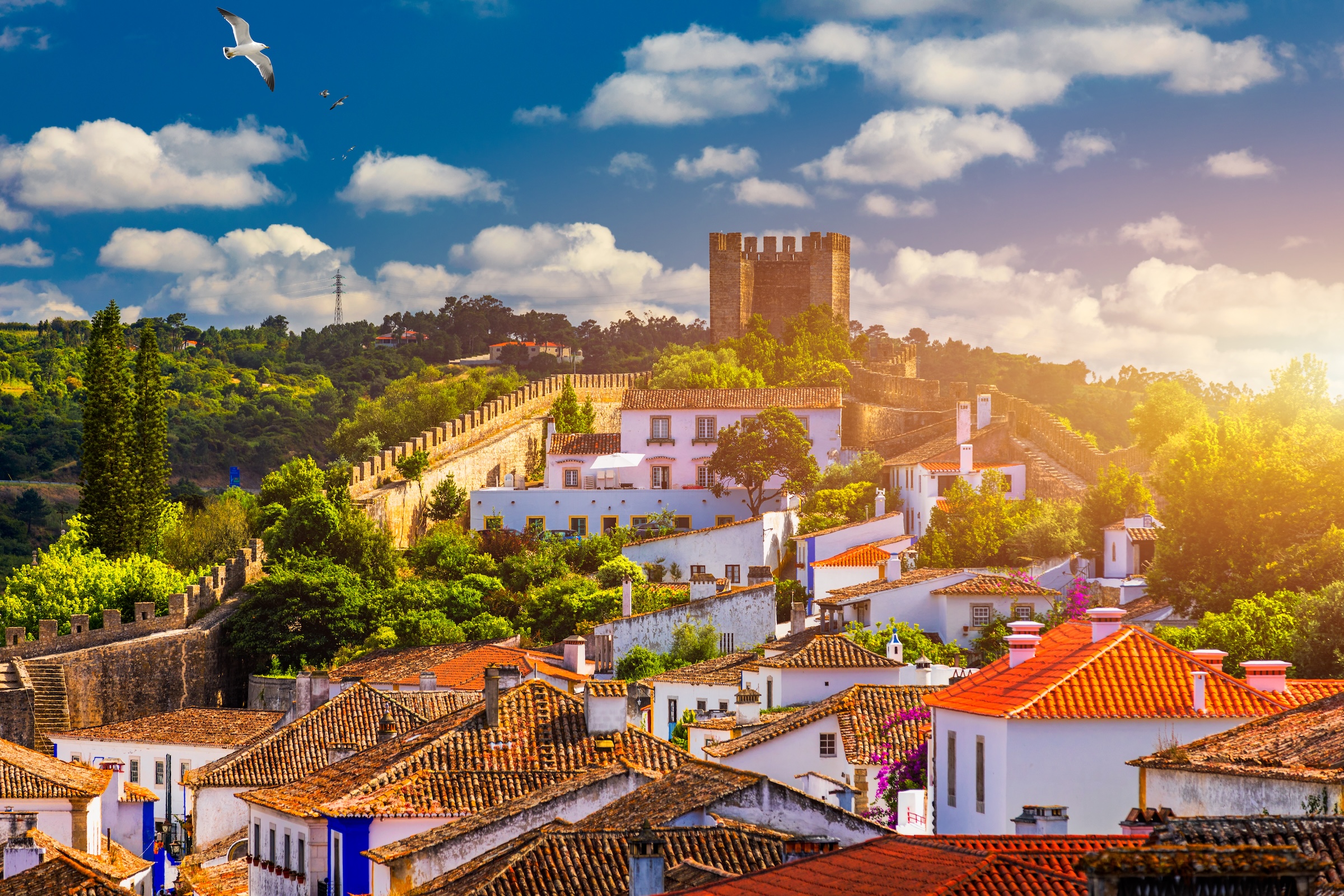
Óbidos is not a medieval town preserved unchanged. Its character comes from successive layers: a strategic hilltop, a fortified royal settlement, Renaissance patronage, Baroque decoration and modern conservation.
01Roman settlement near Óbidos (1st–5th centuries CE)
The Roman city identified as Eburobrittium stood near present-day Óbidos, outside the later walled town. Its excavated remains include public buildings and baths, showing that the area's ancient history cannot be understood from the castle alone. Tip: do not mistake the medieval walls for Roman remains; Eburobrittium is a separate archaeological site, and access should be checked before visiting.
02Islamic rule and the fortified hilltop (8th century–1148)
Following the Muslim conquest of much of the Iberian Peninsula, Óbidos became part of the Islamic political landscape. Its elevated position offered a strong defensive advantage. The standing fortifications, however, reflect substantial later rebuilding. Tip: look at the hill's commanding position from outside the walls rather than assuming every visible tower dates from Islamic rule.
03Afonso Henriques captures Óbidos (1148)
Portugal's first king took Óbidos during the expansion of his kingdom southward, shortly after the conquest of Lisbon in 1147. This brought the settlement under Portuguese Christian rule and began a new phase of royal investment. Tip: compare the main southern entrance with the castle at the northern end to understand the town's elongated defensive layout.
04Royal queens become central to its story (1210–1282)
Afonso II granted Óbidos to Queen Urraca in 1210. Tradition also associates King Dinis's marriage to Isabel in 1282 with the town's presentation as a wedding gift. The lasting historical point is its close connection with the revenues and estates of Portuguese queens. Tip: treat the familiar wedding-gift story as an introduction to royal patronage, not the town's entire history.
05The medieval defences take shape (13th–14th centuries)
Portuguese monarchs strengthened and altered the castle and enclosing walls after the conquest. Much of the silhouette visitors recognise belongs to this evolving medieval defensive system, rather than a single building campaign. Tip: pause where the walls change direction; these angles reveal how builders adapted the defences to the ridge.
06Renaissance patronage transforms the town (16th century)
Royal support helped fund religious buildings, civic improvements and water infrastructure. Queen Catherine of Austria, wife of João III, commissioned the aqueduct that brought water towards Óbidos. Renaissance work also survives in the town's churches and monuments. Tip: include the aqueduct outside the walls; it explains daily urban life better than another castle photograph.
07Josefa de Óbidos and Baroque embellishment (17th–early 18th centuries)
Born in Seville in 1630, Josefa de Óbidos became closely associated with the town and died in 1684. Her religious paintings form an important part of its artistic identity. Later tilework added further richness to local interiors and gateways. Tip: in Santa Maria, seek out her painting of Saint Catherine before turning your attention to the surrounding blue-and-white tiles.
08The earthquake brings damage and repair (1755)
The earthquake of 1 November 1755 damaged buildings in Óbidos, as it did across a much wider area of Portugal. Subsequent repairs contributed to the mixture of medieval structures and later architectural details visible today. Tip: when a church's furnishings look younger than its foundations, remember that rebuilding is part of the historical story.
09The Casa das Rainhas is abolished (1834)
The abolition of the royal queens' household and estates ended the institutional framework behind Óbidos's long association with Portugal's queens. This change belonged to the broader liberal transformation of nineteenth-century Portugal. Tip: revisit the pillory in Praça de Santa Maria with civic authority and administration in mind, rather than seeing it simply as street decoration.
10Conservation, hospitality and literary identity (20th–21st centuries)
Restoration helped establish Óbidos as a major heritage destination. The castle pousada opened in 1950, giving part of the fortified complex a new hospitality role. In 2015, Óbidos joined UNESCO's Creative Cities Network as a City of Literature. Tip: step inside the bookshop in the former Church of São Tiago to see how historic buildings continue to acquire new uses.
Trusted across Portugal and Spain
Journeys backed by 1,300+ verified reviews
Consistently five-star rated since 2012, Portugal Magik is a TripAdvisor Hall of Fame recipient. Our Portugal Ambassadors bring local knowledge, thoughtful service and dependable private travel to every journey.

Travel with Portugal Magik
Explore Portugal in a Mercedes-Benz V-Class
For smaller groups, a private V-Class offers a comfortable way to travel between places, with an English-speaking driver, door-to-door pickup and a flexible itinerary planned with our team. Vehicle choice depends on your group and availability.
Plan a personalized journey →
Historic sites in Óbidos: Where the past remains visible
For visitors searching for historic sites Óbidos can offer within a compact walk, the strongest route runs from Porta da Vila towards the castle, with short detours into churches and quieter lanes. Allow additional time for the aqueduct and sanctuary outside the walls.
01Porta da Vila
The principal gateway provides an immediate lesson in historical layers: a defensive entrance enriched with a chapel and eighteenth-century blue-and-white tiles depicting scenes from Christ's Passion. Tip: step clear of the pedestrian flow before looking upwards; the decoration is easy to miss if you walk straight through towards Rua Direita.
02Óbidos Castle and town walls
The castle occupies the northern end of the ridge, while the walls enclose the historic settlement. Part of the castle functions as a hotel, so do not expect unrestricted access to its interiors. Tip: the wall walk has uneven surfaces, steep approaches and exposed sections without protective railings; a ground-level circuit is a worthwhile alternative, especially with children or limited mobility.
03Igreja de Santa Maria and its square
The main church combines a long religious history with Renaissance features, painted decoration and extensive tilework. Josefa de Óbidos's 1661 painting of Saint Catherine is a key artistic highlight. The square outside contains the town's pillory. Tip: give the interior time for your eyes to adjust, and respect services or temporary access restrictions.
04Igreja de São Pedro
This church is associated with Josefa de Óbidos's burial and contains a richly gilded altarpiece. Its rebuilding after the 1755 earthquake makes it a useful counterpart to Santa Maria when considering how disasters changed the town. Tip: check church opening arrangements before making it the focus of an art-history visit; religious buildings do not necessarily keep museum-style hours.
05Former Igreja de São Tiago
Standing close to the castle, this former church now houses a bookshop. The building was reconstructed after the 1755 earthquake, and its present use connects architectural heritage with Óbidos's literary identity. Tip: look beyond the shelves to appreciate the scale and organisation of the former religious interior.
06Óbidos Aqueduct
Commissioned by Catherine of Austria in the sixteenth century, the aqueduct survives outside the southern side of the walled town. Its long sequence of arches shifts attention from military defence to the practical challenge of supplying water. Tip: view it before entering Porta da Vila or after leaving; this avoids interrupting your walk through the historic centre.
07Santuário do Senhor Jesus da Pedra
Built between 1740 and 1747, this sanctuary stands outside the walls, roughly a kilometre from Porta da Vila. Its unusual hexagonal plan makes it a distinctive addition to the town's religious architecture. Tip: allow a separate stop rather than treating it as another church along Rua Direita; its setting and exterior deserve attention too.
The most rewarding visits alternate major monuments with small details: a worn threshold, a tiled doorway or a lane that follows the slope instead of a straight line. Ask Portugal Magik to shape a personalized itinerary around medieval defences, sacred art or a gentler walk with fewer steps.
How a private guided day brings Óbidos history to life
From central Lisbon, Óbidos is approximately 85 kilometres by road, usually around an hour to an hour and a quarter away, depending on traffic and your pickup location. A private day allows enough time to move beyond Rua Direita without turning the visit into a checklist.
Portugal Magik offers private day and multi-day tours and private Mercedes-Benz transfers, with door-to-door pickup, an English-speaking driver and flexible itineraries. Your Portugal Ambassador is a knowledgeable local English-speaking driver-guide from Portugal who can connect the town's monuments with the wider story of Portuguese kings, queens and everyday life. For smaller groups, a private Mercedes-Benz V-Class is a comfortable option for the journey, subject to availability.
A history-focused day might begin with the aqueduct, continue through Porta da Vila to Santa Maria, and finish near the castle and São Tiago bookshop. The sanctuary can be added before departure. Vehicle access within the old town is restricted, so expect to explore its cobbled streets on foot; door-to-door pickup does not mean driving directly to every monument.
Share your interests and walking preferences when requesting a personalized quote. Portugal Magik can propose a pace that suits you, while church access and any interior visits remain subject to local opening arrangements.
Established in 2012, Portugal Magik has 1,300+ verified reviews. Whether you want a dedicated Óbidos day or a private transfer with a planned sightseeing stop, ask for a route that gives the town's history room to unfold.
Your route
Direct or with stops
Tell us where you would like to pause along the way and we shape the day around it.
Request a proposal →Your pace
One day or several
Spread the journey over a few days with overnight suggestions from our team.
Request a proposal →Your Ambassador
A local by your side
An English-speaking driver-guide from Portugal in a private Mercedes-Benz.
Request a proposal →★★★★★ 1,300+ verified reviews · TripAdvisor Hall of Fame · Since 2012
Keep exploring
Related journeys and routes
The history of Central Portugal: a traveller’s guide
The history of Central Portugal unfolds through Roman houses, frontier castles, royal monasteries and a university that helped shape the country’s intellectual life. This guide connects the major turning points with the places you can visit today, helping you choose a journey with depth rather than simply more stops.
Read more →The history of Silves: from Islamic city to Algarve landmark
The history of Silves follows the fortunes of a riverside city whose red sandstone castle still dominates the Algarve’s inland landscape. Understanding its Islamic prosperity, contested conquests and later decline makes the walk between its castle, cathedral and river much more rewarding.
Read more →The history of Lisbon: A Guide Through the Centuries
The history of Lisbon survives in Roman foundations, medieval lanes, earthquake-resistant buildings and the squares where Portugal changed direction. This guide connects the city’s defining moments with places you can still explore, helping you decide what deserves time on your visit.
Read more →Frequently Asked Questions
Personalized and without obligation
Speak with a travel designer
1,300+ five-star reviews · TripAdvisor Hall of Fame · Trusted since 2012 · Mercedes-Benz fleet