Catholic Places to Visit in the Algarve: A Heritage Guide
Catholic places to visit in the Algarve reveal a region of cathedral towns, tiled parish churches and Marian devotion that extends well beyond the coast. This guide connects ten meaningful stops with practical visiting advice and a pilgrimage-style route that leaves time for prayer.
10 Catholic places to visit in the Algarve
The most rewarding churches in the Algarve are not all large or famous. Some preserve medieval architecture; others tell their story through painted tiles, gilded woodwork or a procession still central to local life. Opening arrangements can change, and sightseeing access does not necessarily coincide with Mass: check parish notices and current visitor information before setting out.
01Igreja de Santa Maria do Castelo, Tavira
Founded in the 13th century after Tavira’s Christian conquest in 1242, this church stands beside the castle on the town’s historic hill. Its fabric reflects medieval origins and rebuilding after the 1755 earthquake. Local tradition associates the church with the burial of seven Christian knights whose deaths preceded the conquest; treat this as a historic devotional tradition, not an authenticated relic display. Check current worship and visitor access separately. Insider tip: approach through the castle quarter rather than expecting a completely level walk from the riverfront.
02Igreja da Misericórdia, Tavira
Construction began in 1541 under André Pilarte, and the Renaissance doorway makes a striking introduction to this church near Praça da República. Inside, 18th-century blue-and-white tiles illustrate the works of mercy, giving the building a particularly clear connection between Catholic teaching and everyday charitable action. It is best approached as a heritage visit rather than a guaranteed daily Mass stop. Insider tip: look at the tile scenes as a sequence, not simply as decoration; they explain the charitable mission of the Misericórdia brotherhood.
03Sé de Faro, Faro Cathedral
Established in 1251 after the Christian conquest, Faro’s cathedral stands in Largo da Sé within the walled old town. Its medieval tower and doorway contrast with richly decorated later chapels, reflecting centuries of rebuilding and embellishment. Allow time for the church and, when accessible, its museum and tower; the latter involves stairs. Cathedral liturgies take priority over sightseeing. Insider tip: reserve a quiet interval in the church before climbing the tower, rather than treating this primarily as a viewpoint over the Ria Formosa.
04Igreja do Carmo and Capela dos Ossos, Faro
Founded in 1719, the Carmelite church is known for its gilded interior and the adjoining bone chapel, inaugurated in 1816. The human remains arranged in the chapel express a Catholic meditation on mortality; they should not be confused with a collection of canonized saints’ relics. Visitor access to the ossuary may follow different arrangements from worship in the main church. Insider tip: start with the church itself so the bone chapel reads as part of a religious setting, not an isolated curiosity. Families should consider whether the display suits their children.
05Igreja de São Lourenço, Almancil
In São Lourenço, just outside central Almancil, this small church contains an exceptional early-18th-century tile interior associated with Policarpo de Oliveira Bernardes. Panels dated 1730 recount the life and martyrdom of Saint Lawrence, covering walls and vaults in blue and white. Visiting periods are limited, and photography restrictions should be respected. Insider tip: bring compact binoculars if you enjoy studying sacred art; the higher scenes are easier to appreciate without trying to photograph them. Confirm access before making this the anchor of your day.
06Igreja Matriz de São Clemente, Loulé
Dating largely from the late 13th century, Loulé’s principal parish church stands in the older streets south of the market. Its Gothic origins and later chapels reward an unhurried visit, while the bell tower is commonly identified with a former mosque’s minaret. This is a living parish, so check locally for Mass and avoid entering as a sightseeing group during services. Insider tip: pair the church with the adjacent Jardim dos Amuados, a peaceful place to pause before continuing through the historic centre.
07Santuário de Nossa Senhora da Piedade, Loulé
Better known through the devotion to the Mãe Soberana, this hilltop sanctuary includes a historic hermitage with 16th-century origins and a modern church. Its annual Easter-season pilgrimage is among the Algarve’s most important Catholic celebrations. The exposed hillside and uphill approach require realistic mobility planning, especially during processions. Confirm which worship spaces are open on your chosen day. Insider tip: on an ordinary weekday, allow time to sit quietly and understand the sanctuary’s relationship with the town below; its significance is devotional, not merely scenic.
08Sé de Silves, Silves Cathedral
Built after the definitive Christian reconquest of Silves in 1249, the cathedral preserves a powerful Gothic character, with later Manueline additions. Its reddish sandstone connects it visually with the neighbouring castle. Silves remained the episcopal seat until the diocese’s seat transferred to Faro in 1577. Look for the restrained nave, architectural details and historic tombs rather than expecting the lavish tilework found elsewhere. Visitor access may pause for religious use. Insider tip: the approach through the old town is steep and cobbled; discuss the closest practical drop-off before arriving.
09Ermida de Nossa Senhora da Rocha, Porches
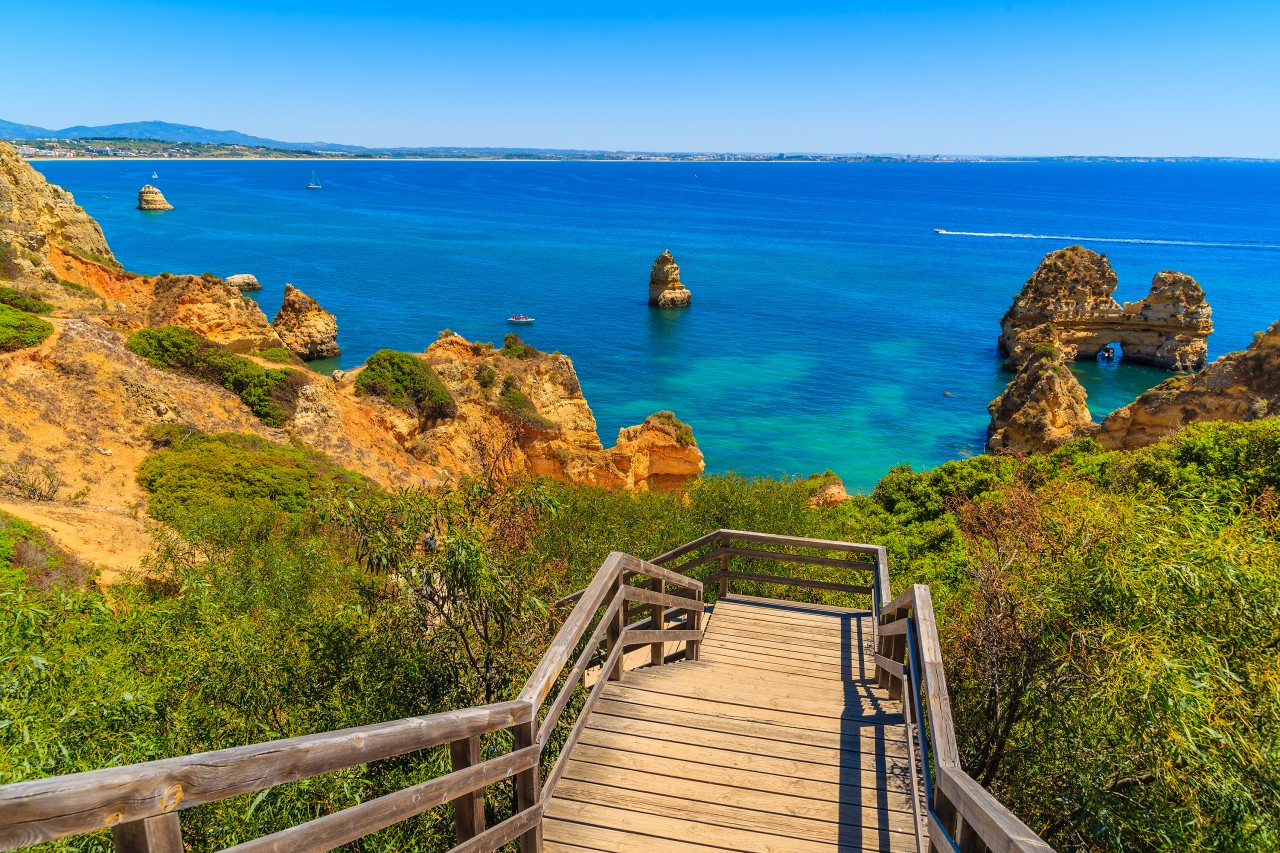
This whitewashed chapel occupies a coastal promontory near Porches, overlooking the shore between Armação de Pêra and Carvoeiro. Its origins are debated, so precise foundation claims deserve caution; surviving architectural details point to several phases of use. The site offers a distinctive setting for Marian reflection, but the chapel interior is not reliably open and should not be treated as a guaranteed Mass stop. Insider tip: visit earlier in the day for a quieter atmosphere, and stay within protected areas near the cliff edges. The promontory is accessible by road on the mainland.
10Igreja de Santo António, Lagos
Rebuilt in 1769 after the 1755 earthquake, this church is celebrated for its exuberant gilded woodcarving, painted ceiling and tilework. Its history is closely connected with the military community in Lagos, and visitor access is associated with the Museu de Lagos Dr. José Formosinho. Plan it as a museum-and-church visit rather than assuming regular parish Mass access. Insider tip: check the combined visitor arrangements before planning lunch or another timed stop; the relatively modest exterior gives little warning of the richly decorated interior.
If you are choosing between these sites, ask Portugal Magik for a personalized route built around your priorities: sacred art, Marian devotion, cathedral history or time for worship.
Trusted across Portugal and Spain
Journeys backed by 1,300+ verified reviews
Consistently five-star rated since 2012, Portugal Magik is a TripAdvisor Hall of Fame recipient. Our Portugal Ambassadors bring local knowledge, thoughtful service and dependable private travel to every journey.

Travel with Portugal Magik
Explore Portugal in a Mercedes-Benz V-Class
For smaller groups, a private V-Class offers a comfortable way to travel between places, with an English-speaking driver, door-to-door pickup and a flexible itinerary planned with our team. Vehicle choice depends on your group and availability.
Plan a personalized journey →
Planning a pilgrimage: the Algarve in three days
This pilgrimage-style itinerary starts in Faro and finishes in Lagos, using Faro as a practical base for the first two nights. It is a flexible devotional journey, not a formally waymarked pilgrimage trail. Arrange any desired Mass first, then fit heritage visits around the confirmed parish timetable.
Day 1: Tavira and Faro — medieval foundations and works of mercy
From Faro, travel approximately 40 km east to Tavira. Begin with Santa Maria do Castelo, allowing for the uphill approach, then descend to the Misericórdia church to study its works-of-mercy tiles. After lunch, return to Faro for the cathedral and, if opening times permit, Igreja do Carmo and its bone chapel. Four interiors make a full day: if you attend Mass or prefer longer prayer stops, leave Carmo for the following morning. Overnight in Faro.
Day 2: Almancil and Loulé — Saint Lawrence and the Mãe Soberana
Start at São Lourenço, roughly 15 km northwest of Faro, with access confirmed in advance. Continue to Loulé for São Clemente and a lunch break in the town centre. Dedicate the afternoon to Nossa Senhora da Piedade rather than squeezing the sanctuary between shopping stops. On procession days, traffic restrictions and crowds can reshape the whole day; outside festival periods, this is the itinerary’s best opportunity for a slower devotional rhythm. Return to Faro for the night.
Day 3: Silves, Porches and Lagos — cathedral, coastal chapel and sacred art
Travel approximately 65 km from Faro to Silves, where the cathedral deserves the morning’s attention. Continue around 20 km to Nossa Senhora da Rocha near Porches for an outdoor pause, with interior access treated as a possibility rather than a promise. Finish in Lagos, roughly another 45 km west, timing Santo António around the museum’s visiting hours. Stay in Lagos or request an onward private transfer; a return to Faro adds roughly 90 km and should be planned explicitly.
For travellers beginning in Lisbon, reaching the central Algarve usually takes around three hours by road before breaks and traffic. A transfer day followed by overnight stays is more rewarding than trying to combine the drive with a comprehensive pilgrimage circuit.
Portugal Magik offers private Mercedes-Benz transfers and private day or multi-day tours with door-to-door pickup and flexible itineraries. Your Portugal Ambassador is a knowledgeable local English-speaking driver-guide from Portugal who can provide context and help pace the journey. A private Mercedes-Benz V-Class is a comfortable option for smaller groups, subject to availability. Request a personalized itinerary with your preferred churches, walking limits and any confirmed worship times.
Feast days, dress code and respectful visiting
Mãe Soberana, Loulé: The Festa Pequena traditionally takes place on Easter Sunday, when the image of Nossa Senhora da Piedade descends from the sanctuary to Igreja de São Francisco. The Festa Grande follows two weeks later, culminating in the image’s return uphill. Dates therefore change each year. Check the current programme and expect road restrictions, dense crowds and limited vehicle access near the celebrations.
Holy Week and Easter: Faro, Tavira and other Algarve parishes hold liturgies and, where scheduled, processions. These are acts of worship rather than visitor performances. Confirm the local programme instead of assuming that every town follows the same schedule.
Patronal feast days: Saint Anthony’s feast is 13 June, and Saint Lawrence’s is 10 August. These dates offer useful context for Lagos and Almancil respectively, but they do not guarantee that the churches listed here will have public celebrations or extended opening hours. The Assumption on 15 August is also an important Catholic feast and a Portuguese public holiday.
Dress: Clothing covering shoulders and knees is a considerate choice, especially for Mass and sanctuary visits. Remove hats inside churches. A light shawl is useful in summer, while supportive shoes matter on the cobbles and slopes of Tavira, Silves and Loulé.
Etiquette: Silence phones, keep voices low and avoid walking through congregations during worship. Do not photograph people praying without permission, and follow each church’s photography rules. Visitors are welcome to attend Mass respectfully; receiving Communion follows Catholic sacramental discipline. Observe barriers around altars, tombs and devotional objects.
Practical planning: Churches may close between visiting periods or restrict access for funerals, weddings and other services. Museum-style admission and worship access are different arrangements. Tell Portugal Magik if step-free access, reduced walking or a particular Mass is central to your journey, so the proposed route can reflect those needs without assuming every historic building is accessible.
Your route
Direct or with stops
Tell us where you would like to pause along the way and we shape the day around it.
Request a proposal →Your pace
One day or several
Spread the journey over a few days with overnight suggestions from our team.
Request a proposal →Your Ambassador
A local by your side
An English-speaking driver-guide from Portugal in a private Mercedes-Benz.
Request a proposal →★★★★★ 1,300+ verified reviews · TripAdvisor Hall of Fame · Since 2012
Keep exploring
Related journeys and routes
A guide to catholic places to visit in Sintra
The catholic places to visit in Sintra range from working parish churches to royal chapels and a Franciscan convent built around granite boulders. This guide distinguishes places for worship from ticketed monuments, helping you plan a thoughtful visit without mistaking every historic chapel for an active church.
Read more →A guide to catholic places to visit in Guimarães
The catholic places to visit in Guimarães connect Portugal’s medieval beginnings with living traditions of worship, Marian devotion and pilgrimage. Follow this guide from the churches of the historic centre to the granite sanctuary of Penha and the revered relics of São Torcato.
Read more →Catholic places to visit in Portugal: A faith-led guide
The Catholic places to visit in Portugal connect living traditions of prayer with medieval monasteries, saints’ stories and some of the country’s finest sacred art. This guide helps you choose meaningful stops, leave time for worship and build a comfortable journey from Lisbon to Fátima and beyond.
Read more →Frequently Asked Questions
Personalized and without obligation
Speak with a travel designer
1,300+ five-star reviews · TripAdvisor Hall of Fame · Trusted since 2012 · Mercedes-Benz fleet