A guide to catholic places to visit in Sintra
The catholic places to visit in Sintra range from working parish churches to royal chapels and a Franciscan convent built around granite boulders. This guide distinguishes places for worship from ticketed monuments, helping you plan a thoughtful visit without mistaking every historic chapel for an active church.
8 catholic places to visit in Sintra
These sites are in Sintra town and the surrounding municipality, not all within walking distance of one another. Parish churches may open chiefly around services, while monument admission does not necessarily include unrestricted chapel access. Confirm current arrangements before planning a visit around Mass or a particular interior.
01Igreja de São Martinho
Just above Sintra’s historic centre, this parish church traces its foundation to the period following Afonso Henriques’s conquest of the town in 1147. The building suffered badly in the 1755 earthquake and was subsequently reconstructed. Its significance is as much devotional as architectural: this remains a working Catholic church beside the palace quarter. Look for the historic religious paintings inside when access permits. Mass/visiting notes: consult the parish’s current notices rather than assuming a daily tourist opening schedule. Insider tip: visit before exploring the National Palace, but leave sightseeing until after any service has finished.
02Igreja de Santa Maria
On the hillside between the historic centre and São Pedro, Santa Maria preserves an unusually clear encounter with medieval Sintra. Its origins reach back to the 12th century, while much of its Gothic character belongs to subsequent medieval rebuilding. Look at the pointed entrance and the sturdy proportions of the church rather than expecting lavish royal decoration. Mass/visiting notes: interior access can be limited; do not build a pilgrimage day around an unconfirmed service here. Insider tip: the surrounding lanes are steep and uneven, so arrange the day around your walking comfort rather than relying on the short distance shown on a map.
03Igreja de São Pedro de Penaferrim
In the São Pedro district, this parish church brings together medieval origins and later Portuguese decorative traditions. Its Gothic chancel and blue-and-white tile panels reward a slower look, particularly if your interest extends beyond Sintra’s palaces. This is a living parish setting, not simply an architectural stop. Mass/visiting notes: check the current parish timetable and expect sightseeing to pause during liturgies, weddings and funerals. Insider tip: allow time to sit quietly before examining the decoration; among the churches in Sintra, São Pedro is especially worthwhile for visitors seeking continuity between historic art and present-day worship.
04Capela do Palácio Nacional de Sintra
The royal chapel inside the National Palace belongs to the palace’s medieval religious heritage. Its foundation is associated with King Dinis, and its distinctive decoration includes painted doves and an ornate timber ceiling influenced by Islamic artistic traditions. Together, these details make it a particularly revealing place to consider the artistic language of Portugal’s royal court. Mass/visiting notes: this is a ticketed palace visit, not a dependable option for public Mass, and access follows the monument’s visitor arrangements. Insider tip: look upward as well as along the walls; the chapel’s quieter decorative details can be overlooked after the palace’s larger ceremonial rooms.
05Capela de Nossa Senhora da Pena
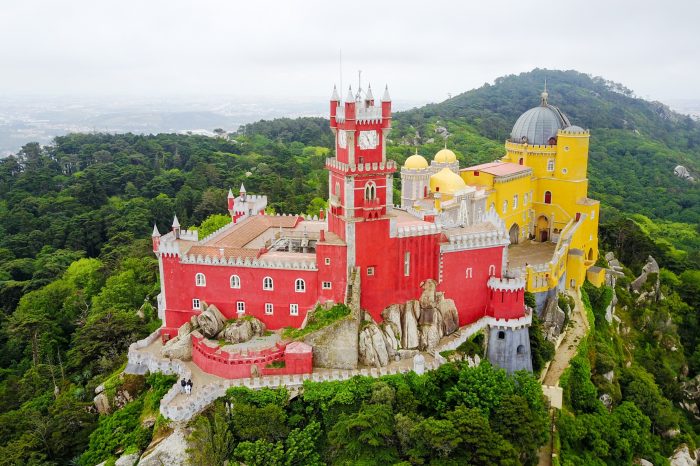
Pena’s Catholic history predates its colourful Romantic palace. King Manuel I established a Hieronymite monastery here in the early 16th century; Ferdinand II acquired the former monastery in 1838 and incorporated it into his palace project. The chapel’s outstanding work is the alabaster-and-marble altarpiece by Nicolau Chanterene, made between 1529 and 1532. Mass/visiting notes: treat this as a heritage visit, with admission and chapel access checked for your chosen date, rather than a scheduled worship stop. Insider tip: ask specifically about chapel access when choosing your palace visit; access to the park alone should not be assumed to include it.
06Convento dos Capuchos
Founded in 1560 by Dom Álvaro de Castro, this Franciscan convent expresses an ideal of poverty through tiny cells, low doorways and cork-lined spaces fitted around the mountain’s granite. Its church, communal rooms and intimate scale offer a striking counterpoint to the royal palaces. The religious community ended with the dissolution of Portugal’s religious orders in 1834. Mass/visiting notes: Capuchos is a ticketed heritage monument, not an operating monastery with a regular public liturgical timetable. Insider tip: wear shoes with reliable grip and assess mobility needs carefully; damp stone, irregular surfaces and confined passages are central to the experience, not incidental obstacles.
07Santuário da Peninha
High on the western side of the Sintra hills, Peninha is associated with devotion to Nossa Senhora da Peninha and a local tradition of a Marian apparition to a shepherdess. Present that story as devotional tradition rather than documented eyewitness history. The chapel dates from the late 17th century and is known for its tiled interior, although access inside is not assured. Mass/visiting notes: this is not a reliable everyday Mass stop; confirm religious events and site access separately. Insider tip: choose a clear, calm day and check mountain-access restrictions before setting out. Exposed paths, wind and mist can make this a poor choice for visitors with limited mobility.
08Igreja de Nossa Senhora da Assunção, Colares
In the old village of Colares, west of Sintra town, this parish church adds a village-scale perspective to a Catholic heritage route. Its architecture and furnishings reflect successive rebuilding and enrichment, including gilded woodwork and Portuguese tile decoration. The dedication to Our Lady of the Assumption makes it especially relevant to visitors interested in Marian devotion beyond the better-known hilltop sites. Mass/visiting notes: check parish announcements for services and opening; village churches should not be assumed to operate continuous visitor hours. Insider tip: pair Colares with Capuchos geographically, rather than crossing back through central Sintra between the two.
If prayer, sacred art or monastic history is your priority, tell Portugal Magik which matters most. A personalized route can give a few well-chosen places the time they deserve instead of trying to collect all eight in one day.
Trusted across Portugal and Spain
Journeys backed by 1,300+ verified reviews
Consistently five-star rated since 2012, Portugal Magik is a TripAdvisor Hall of Fame recipient. Our Portugal Ambassadors bring local knowledge, thoughtful service and dependable private travel to every journey.

Travel with Portugal Magik
Explore Portugal in a Mercedes-Benz V-Class
For smaller groups, a private V-Class offers a comfortable way to travel between places, with an English-speaking driver, door-to-door pickup and a flexible itinerary planned with our team. Vehicle choice depends on your group and availability.
Plan a personalized journey →A pilgrimage-style private itinerary from Lisbon
For a reflective day, choose three principal visits: São Martinho, the National Palace chapel and Capuchos. Add one parish church only if its opening and your energy allow. Sintra is approximately 30 kilometres from central Lisbon, but traffic, mountain roads and monument access make fixed journey-time promises unhelpful.
Morning: begin with worship, if available. Arrange door-to-door pickup in Lisbon and travel to Sintra with an English-speaking driver. If attending Mass is essential, confirm the service first and build the departure around it. São Martinho is a natural starting point for the historic centre; São Pedro de Penaferrim is an alternative when its parish schedule fits better. Allow time to arrive before the liturgy, rather than walking in with a sightseeing group once it has begun.
Late morning: visit the National Palace chapel. Continue into the palace for the chapel’s painted doves, timber ceiling and royal context. This requires a palace visit rather than a quick street-side church stop. Leave room for the rest of the visitor route and any entrance queues. If Santa Maria is of particular interest, consider a short additional stop, with its interior treated as unconfirmed until checked.
Lunch: pause in Sintra or São Pedro. Keep lunch unhurried and avoid adding a distant detour. A pilgrimage-style day benefits from time to absorb what you have seen, not simply from a longer list of addresses.
Afternoon: spend time at Capuchos. Travel into the hills for the convent’s austere spaces and close relationship with the surrounding woodland. Allow roughly 60–90 minutes, adjusted to mobility and interest. Finish with quiet reflection before returning to Lisbon. If Capuchos is unsuitable because of access or walking difficulties, ask about substituting a parish visit in Colares, subject to opening.
Save Pena and Peninha for a different emphasis. Pena works better on a palace-focused day; Peninha depends particularly on weather and access. Trying to include both alongside worship, the National Palace and Capuchos would undermine the slower rhythm of this route.
Portugal Magik offers private day and multi-day tours and private Mercedes-Benz transfers, with door-to-door pickup and flexible itineraries. Your Portugal Ambassador is a knowledgeable local English-speaking driver-guide from Portugal who can explain the setting and adapt the journey to practical conditions. Vehicle access restrictions still apply, and some entrances require walking. For smaller groups, a private Mercedes-Benz V-Class is a comfortable option, subject to availability. Request a personalized itinerary with your preferred Mass, walking limits and essential sites clearly noted.
Feast days, dress code and pilgrimage etiquette
Feast days to know. Easter and Holy Week are central to Catholic life, but their dates change annually. Parish liturgies take precedence over sightseeing, and additional services do not necessarily mean longer visitor opening hours. Corpus Christi is also a movable feast; check parish notices for any local procession rather than assuming one will take place along your route.
Local dedications offer useful dates to investigate: 29 June is the Solemnity of Saints Peter and Paul, relevant to São Pedro de Penaferrim; 15 August is the Assumption of Our Lady, particularly relevant to Colares; and 11 November is Saint Martin’s Day, associated with São Martinho. A patronal feast may be celebrated locally on a nearby weekend. None of these dates guarantees a procession, a special concert or access to a normally closed chapel.
Dress for both worship and the hills. Covered shoulders and clothing reaching approximately to the knees are a respectful choice for churches. Remove hats inside and carry a light layer: the Sintra hills can be cool and damp even when Lisbon feels warm. Stable footwear matters more than formal shoes at Capuchos and Peninha.
During Mass. Silence phones, avoid moving around to inspect artworks and do not photograph worshippers without permission. Visitors of other faiths or none are welcome to attend respectfully. Holy Communion is ordinarily for Catholics properly disposed to receive it; other visitors can remain quietly in their place.
Photography and sacred objects. Follow each site’s rules on photography, flash and restricted areas. Do not step into a sanctuary, touch devotional objects or move barriers for a better photograph. Light candles only where permitted and use the designated holders. An old chapel or devotional statue should not automatically be described as a relic: this route does not promise access to authenticated saints’ relics.
Check shortly before travelling. Parish schedules, monument access and mountain-road restrictions can change, including during periods of elevated wildfire risk. If pilgrimage in Sintra is the purpose of your journey, confirm worship arrangements directly with the parish and share them when requesting your private tour. Transport planning and religious-service confirmation are separate tasks.
Your route
Direct or with stops
Tell us where you would like to pause along the way and we shape the day around it.
Request a proposal →Your pace
One day or several
Spread the journey over a few days with overnight suggestions from our team.
Request a proposal →Your Ambassador
A local by your side
An English-speaking driver-guide from Portugal in a private Mercedes-Benz.
Request a proposal →★★★★★ 1,300+ verified reviews · TripAdvisor Hall of Fame · Since 2012
Keep exploring
Related journeys and routes
A guide to catholic places to visit in Guimarães
The catholic places to visit in Guimarães connect Portugal’s medieval beginnings with living traditions of worship, Marian devotion and pilgrimage. Follow this guide from the churches of the historic centre to the granite sanctuary of Penha and the revered relics of São Torcato.
Read more →Catholic places to visit in Portugal: A faith-led guide
The Catholic places to visit in Portugal connect living traditions of prayer with medieval monasteries, saints’ stories and some of the country’s finest sacred art. This guide helps you choose meaningful stops, leave time for worship and build a comfortable journey from Lisbon to Fátima and beyond.
Read more →A guide to catholic places to visit in Northern Portugal
The most rewarding catholic places to visit in Northern Portugal connect living worship with Romanesque cathedrals, Benedictine monasteries and hillside sanctuaries. Start in Porto, give Braga time beyond its famous stairway, and follow a thoughtful route through Guimarães to Lamego.
Read more →Frequently Asked Questions
Plan a thoughtful Catholic heritage day in Sintra
Request a personalized private tour or Mercedes-Benz transfer quote, with your preferred churches, worship times and walking needs in mind. Established in 2012, Portugal Magik helps you shape a flexible journey with a knowledgeable local English-speaking Portugal Ambassador.
Personalized and without obligation
Speak with a travel designer
1,300+ five-star reviews · TripAdvisor Hall of Fame · Trusted since 2012 · Mercedes-Benz fleet